
Why Does My Disposable Vape Not Work? Common Causes & Fixes
Oct 10th 2026
What if the safest fix for a disposable vape that won’t work is knowing when not to force it? If you’re asking, “Why Does My Disposable Vape Not Work?”, a lack of vapor or response can be frustrating, especially when it’s unclear whether the device is depleted, blocked, or faulty.
The symptoms can offer clues. A vape with no response may have a depleted battery or have reached the end of its usable life, while restricted airflow can prevent vapor from coming through. But no single symptom confirms the cause. This guide covers common reasons a disposable vape stops working and limited, non-invasive checks you can try. It also explains when to stop using the device and replace it. Don’t open or modify a sealed vape, and only charge a rechargeable model if its manufacturer’s instructions allow it. If the device is depleted or damaged, dispose of it through an e-waste recycling option rather than household trash.
Key Takeaways
- Start with the symptom: no response, weak vapor, and restricted airflow can have different possible causes.
- Use a brief external check sequence and follow the device’s instructions. Don’t insert objects or liquids into openings or ports.
- Why Does My Disposable Vape Not Work? Symptoms can offer clues, but they can’t confirm a diagnosis on their own.
- Know which warning signs mean it’s time to stop troubleshooting and stop using the device.
- If permitted checks don’t help, follow the device instructions rather than attempting to repair sealed components.
Why does a disposable vape stop working? Start with the symptom
Several problems can produce similar results, so start by observing what happens when you try to use the device. Does it give no response, produce less vapor than usual, feel difficult to draw through, or behave differently than expected? These clues can narrow down possibilities, but they can’t confirm a cause on their own. A disposable vape fault is a symptom, not a diagnosis.
Disposable vapes share basic components, but their designs and features vary. Some have an indicator light or screen; others don’t. Some models have a charging port, while others aren’t rechargeable. The Electronic cigarette overview explains common device components and types. For a particular vape’s controls or indicators, follow its own instructions.
What does the device do when you try to use it?
Notice whether an indicator responds, whether air moves through the mouthpiece, and whether you hear anything or get vapor. Don’t assume a light or screen signals a specific fault: its meaning depends on the model and manufacturer instructions. Note whether the device never worked or stopped after previously working. A new device with no response and one that stops after use may have different explanations.
Common causes that can appear similar
Use the symptom as a starting point, not proof. A depleted battery or depleted e-liquid may both leave a device producing little or no vapor. Restricted airflow can also reduce vapor or make drawing feel difficult. If the device gives no response, a battery issue is one possibility, but an internal malfunction can produce a similar result.
The same sign can mean different things across models. A blinking indicator, for example, has no universal meaning, and not every disposable vape has one. Check the product instructions before interpreting it. A burnt taste can also have more than one explanation. Stop using the device if the taste persists rather than trying to force it to work.
- No response: The battery may be depleted, or the device may be malfunctioning. Check whether the model has an indicator and what its instructions say.
- Weak or absent vapor: The e-liquid or battery may be depleted, or another fault may be affecting operation.
- Restricted airflow: An opening may be obstructed, or the device may have an internal issue. Don’t insert anything into it.
- Unexpected indicator behavior: Consult the device instructions rather than guessing from a light or screen pattern.
These distinctions help you describe the problem clearly before deciding what to do next. If you’re still asking, “Why Does My Disposable Vape Not Work?”, be specific about what changed, what the device does now, and whether it ever worked. The next section covers safe external checks without opening or modifying the device.
How to troubleshoot a disposable vape safely, step by step
Limit troubleshooting to what you can observe from the outside. A disposable vape is a sealed device, and trying to reach its internal parts can damage the battery or other components. If you’re wondering, “Why Does My Disposable Vape Not Work?”, follow this sequence and stop if you notice damage, leakage, or unusual heat.
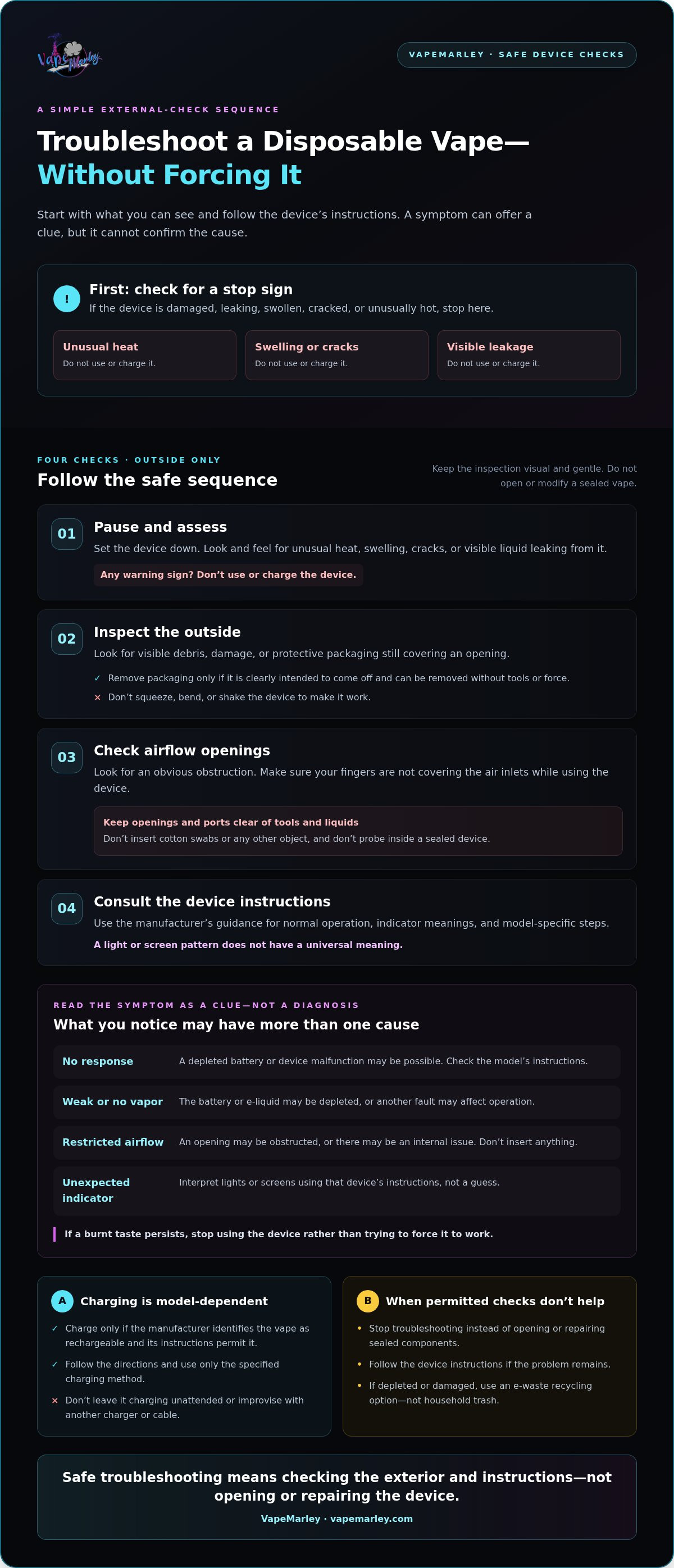
- Pause and assess. Set the vape down and check whether it feels unusually hot, looks swollen or cracked, or has visible liquid leaking from it. If you notice any of these signs, don’t use or charge it. The CDC Quick Facts on E-cigarette Risks discusses battery hazards, including fires and explosions associated with defective batteries.
- Inspect the outside. Look for visible debris, damage, or protective packaging that may still cover an opening. Remove packaging only if it is clearly intended to come off and can be removed without tools or force. Don’t squeeze, bend, or shake the device to make it work.
- Check the airflow openings. Look for an obvious obstruction and make sure your fingers aren’t covering the air inlets while you use the device. Don’t insert tools, cotton swabs, liquids, or any other object into the mouthpiece, airflow openings, or ports. Don’t try to clear a blockage inside the sealed device by probing it.
- Consult the device instructions. Use the manufacturer’s guidance to identify normal operation, indicator meanings, and model-specific steps. Don’t assume a light pattern or screen message means the same thing on every vape.
External checks that don’t require opening the device
Keep the inspection visual and gentle. Check the mouthpiece and exterior openings for anything plainly obstructing them, and look for leakage or damage. If a protective cap or sticker is present, remove it only as directed by the packaging or instructions. Don’t try to clean inside the device or repair a loose component. If an exterior check doesn’t resolve the issue, follow the manufacturer’s guidance rather than escalating to a DIY fix.
When charging is and isn’t an option
Some disposable vapes are rechargeable; others aren’t. A charging port alone isn’t a reason to guess how the device should be charged. Only charge it if the manufacturer identifies it as rechargeable and its instructions permit charging. Follow those directions, use only the specified charging method, and don’t leave the device charging unattended. Never improvise with a different charger or cable. If the vape is damaged, leaking, unusually hot, or behaving abnormally, don’t charge or continue using it.
Safe troubleshooting means checking the exterior and instructions, not opening or repairing the device. If permitted checks don’t help, stop rather than forcing a fix. If the device has reached the end of its usable life, a replacement disposable vape may be the practical next step. Browse the disposable vape selection to explore available options.
What the symptoms may mean, and when to stop troubleshooting
Symptoms can point toward possible causes, but they can’t confirm what’s happening inside a sealed vape. Use the table as a guide, then follow the device’s instructions if they differ. If a symptom persists after permitted external checks, don’t dismantle the device to investigate.
| Symptom | Possible explanation | Safe next step | Stop-use signal |
|---|---|---|---|
| No vapor or very weak vapor | The battery or e-liquid may be depleted, airflow may be restricted, or the device may have a fault. | Check only for visible obstructions around the airflow openings and consult the model’s instructions. | Stop if the device is damaged, leaking, unusually hot, or has an abnormal odor. |
| Hard to draw through | An opening may be obstructed, or an internal issue may be affecting airflow. | Make sure you aren’t covering the air inlets. Don’t probe or insert anything. | Stop if the device shows damage or leakage. |
| Blinking or unexpected indicator behavior | The meaning may vary by model; it could relate to a device state or fault. | Check the manufacturer’s instructions for that specific light or screen behavior. | Stop if the device is hot, swollen, leaking, damaged, or smells unusual. |
| Burnt taste | This may indicate an issue with the device or its contents, but taste alone can’t identify the cause. | Stop using it if the burnt taste persists; don’t try to revive it by opening or modifying it. | Stop using it if the taste continues or another warning sign appears. |
No vapor, weak draw, or little response
These symptoms overlap. A restricted opening, depleted battery, depleted e-liquid, or device malfunction could each contribute, and the same behavior may have different explanations on different models. Inspect visible airflow openings only, then check the device instructions. For more detail on draw problems, see this disposable vape not-hitting guide. It offers additional context, but it can’t diagnose a particular device.
Blinking, unusual heat, leakage, or visible damage
There’s no universal meaning for a blinking light. Use the model’s instructions rather than interpreting a flash pattern by guesswork. A hot, swollen, leaking, damaged, or unusually odorous device is a reason to stop using it. Don’t charge, test, or attempt to cool a device showing abnormal heat or visible damage. Set it aside and follow appropriate local guidance for disposal.
If you’re still asking, “Why Does My Disposable Vape Not Work?”, treat persistent failure after permitted checks as a stop point, not an invitation to open the casing or handle the battery. A sealed disposable isn’t designed for user disassembly or component repair.
Can you fix a disposable vape, or should you stop using it?
Most sealed disposable vapes aren’t designed for user disassembly or component repair. You can make limited external checks, such as looking for visible packaging or an obstruction around an airflow opening. If those checks and the manufacturer’s instructions don’t resolve the problem, stop troubleshooting rather than trying to reach the battery or internal parts.
That boundary matters because a disposable may contain a lithium-ion battery and electronic components inside its casing. Opening the device or handling its battery can create new hazards and may damage the device further. A persistent fault isn’t a reason to force the casing open, even if you’re trying to determine why it stopped working.
Why opening or forcing a disposable isn’t a safe fix
Don’t puncture, rewire, remove, or bypass internal components. Avoid prying apart the casing or trying to reconnect a loose part. These actions go beyond an external check and can expose or damage components that aren’t intended for user repair. If the problem remains after checks allowed by the instructions, stop using the vape. A sealed device that won’t work may need to be replaced, not repaired at home.
There’s also a clear stop-use line. Don’t use or charge a device that’s damaged, leaking, swollen, unusually hot, or giving off an unusual odor. Don’t attempt to test whether it still works. If you’re asking, “Why Does My Disposable Vape Not Work?”, the answer may remain uncertain without an internal inspection, and attempting one isn’t worth the risk.
Replacing and disposing of a failed device
If the device is new or failed earlier than expected, check its packaging and manufacturer instructions for any warranty or support process. Keep any purchase details the instructions request. A replacement may be the practical next step when the vape is depleted or faulty, but a different device can’t guarantee a particular cause or outcome.
Dispose of a failed vape according to the manufacturer’s directions and local battery or electronic-waste guidance. Disposal options and instructions can vary by location, so don’t assume a single method applies everywhere. If the vape shows damage or abnormal heat, follow applicable local guidance for handling and disposal rather than putting it back into use.
- Reasonable: visually inspect the outside, remove clearly intended packaging, and consult the device instructions.
- Not a safe repair: opening the casing, probing openings, or handling internal wiring or the battery.
- Stop using it: if it’s damaged, leaking, swollen, unusually hot, or has an unusual odor.
If the device can’t be used after permitted checks, replacing it is more appropriate than attempting a repair. You can browse disposable vapes as you consider a replacement, without assuming any particular device will resolve the underlying issue.
What to do next if your disposable vape still does not work
Once you’ve completed the checks allowed by the manufacturer, decide based on what happened. Don’t repeat forceful draws, shake the device, or try increasingly invasive fixes. A persistent fault is a signal to stop troubleshooting, not a reason to open the casing.
A simple decision path for a device that still fails
- It works after a permitted check: Use it only as directed, and stop if a warning sign appears or the problem returns.
- You’re unsure what an indicator or control means: Consult the device’s own instructions. Lights, screens, buttons, and charging features vary by model, so general advice may not apply. For a Mr Fog Aura device, the Mr Fog Aura model guide may provide relevant model-specific context, but the manufacturer’s instructions should guide operation.
- It remains unresponsive after permitted checks: Stop using it and review the manufacturer’s support, warranty, or disposal instructions. Don’t dismantle it or keep trying to activate it.
- It shows damage, leakage, unusual heat, or another warning sign: Don’t use or charge it. Follow the manufacturer’s guidance and local disposal instructions.
This keeps the decision simple: if a safe check resolves the issue, follow the device directions; if the instructions don’t clarify the behavior, consult the manufacturer; if the device still fails or shows a warning sign, stop using it.
Choose a responsible next step
For questions about a device’s particular controls, warranty, or disposal, start with its packaging or manufacturer guidance. This is especially useful if you’re asking, “Why Does My Disposable Vape Not Work?” and need to understand whether a specific light pattern or feature is normal. Avoid treating instructions for another model as a diagnosis.
If the vape can’t be used after permitted checks, replacement is one option, not an obligation. Consider it only after addressing safe handling and disposal of the failed device. If you’re comparing options, the disposable vape brands and flavors guide can help you explore categories without suggesting that a particular device will fix the fault.
Still unsure? Follow the manufacturer’s next-step guidance rather than experimenting. If you decide a replacement suits your needs, browse VapeMarley’s disposable vape selection.
Make your next choice with confidence
Not every device that stops working has an obvious explanation. If you’re still wondering, “Why Does My Disposable Vape Not Work?”, let the manufacturer’s instructions guide model-specific decisions, and don’t let uncertainty push you into opening or forcing a sealed device. Sometimes the most useful next step is to stop and choose what’s right for you.
If you decide to replace it, explore options at your own pace and consider what features and style suit your preferences. VapeMarley’s online storefront offers disposable vapes and accessories, with age verification included in the purchasing experience.
Explore VapeMarley’s disposable vape selection when you’re ready to browse. Make an informed next step, and feel confident leaving a device behind when it’s time.
Frequently Asked Questions
Why is my disposable vape not working even though it is new?
A new disposable vape may be faulty, depleted, or not operating as its instructions describe. Check the packaging for protective pieces and read the setup directions before drawing conclusions. If it still doesn’t respond, note when you first tried it and keep the packaging and purchase details. Those specifics can help when following the manufacturer’s support or warranty process. Don’t open the device to investigate.
Can I charge a disposable vape that is not working?
Only charge it if the manufacturer identifies that specific model as rechargeable and its instructions permit charging. A port by itself doesn’t confirm that charging is appropriate or explain how to do it. If instructions allow charging, follow them exactly; don’t improvise with another power source. If the device is damaged, leaking, unusually hot, or behaving abnormally, don’t charge it.
What should I do if my disposable vape has airflow but no vapor?
Air passing through doesn’t confirm that the device can produce vapor. The battery or e-liquid may be depleted, or an internal fault may be affecting operation. Check the device instructions and any visible indicator, if present, without assuming a particular signal applies to every model. Avoid repeated hard draws or attempts to clear internal parts. If it remains unusable, stop and follow the manufacturer’s guidance.
Why does my disposable vape blink but not hit?
A blinking light can have different meanings depending on the model, so use the manufacturer’s instructions to interpret the exact pattern. If the device has a screen, note any displayed message as well. Don’t rely on a blinking code from another brand or model. If the instructions don’t explain the behavior, or the vape still won’t operate, stop using it rather than trying to reset or modify it.
Is it safe to use a disposable vape that is leaking or getting hot?
No. Don’t use or charge a vape that is leaking or unusually hot, and don’t test it to see whether it still works. If you can do so without handling a hot or damaged device, keep it away from use and follow its manufacturer’s guidance. Disposal instructions can depend on local battery and electronic-waste options, so follow applicable local guidance rather than putting it into regular trash.
Can you repair a disposable vape that has stopped working?
Sealed disposable vapes generally aren’t designed for user repair, so don’t open the casing or handle internal components. If it stopped working, record the model and symptoms, then consult the manufacturer’s support or warranty instructions. If the device can’t be used after the checks its instructions permit, follow the manufacturer’s disposal guidance and consider replacement only if that suits you.