
What Is a Mesh Coil in a Vape? How It Works and Why It Matters
Posted by Silar on Oct 20th 2026
A coil’s shape can affect how a vape heats e-liquid and feels to use. A mesh coil in a vape uses a grid-like strip of metal as its heating surface. The battery warms the metal, which heats e-liquid absorbed by the wick and turns it into vapor. Its wider surface can heat more evenly than a traditional wound-wire coil, but mesh isn’t the right fit for every device or preference.
Mesh coils can offer a different balance of heating, flavor, vapor, e-liquid use, and battery use, so consider how those trade-offs fit your preferences. This guide explains how mesh coils are built and work, how their lifespan compares with regular coils, and what practical advantages and drawbacks to consider. You’ll also learn how mesh and traditional coils differ, so you can judge what the design means for your vaping experience.
Key Takeaways
- Identify mesh coils by their grid-shaped metal heating surface, which contacts the wick across a wider area than wound wire.
- Compare mesh and regular coils by how they heat e-liquid and the flavor and vapor experience you prefer.
- Use coil lifespan as a guide, not a fixed schedule; e-liquid, wattage, and vaping frequency all affect replacement timing.
- Weigh mesh’s quick, even heating against its potential for higher e-liquid and battery use before choosing a coil style.
- Use the comparison to decide whether disposable vapes, vape accessories, or a vape bundle best fits your next step.
What Are Mesh Coils?
Mesh coils use a grid-shaped metal heating surface, which can warm e-liquid more evenly than wound-wire coils. Their wider contact with the wick can support fuller flavor and vapor production; for a mesh tank, a device operating around 50-80 watts should work, but follow the coil’s rated range.
Flavor Production
Mesh coils spread heat across a broad, flat surface that touches the wick. This even contact can help deliver consistent flavor throughout a puff, while a wound-wire coil concentrates heat along its wire. With a familiar e-liquid, the difference may be noticeable: mesh can bring out a steady flavor, while a traditional coil may taste less uniform as its heated areas vary.
Even heating doesn’t make every flavor taste identical. E-liquid composition, coil condition, and device power settings all affect the result. If a flavor seems muted, check that the wick is saturated and that the coil is operating within its specified wattage range.
Vapor Production
A mesh coil’s larger heating area can vaporize e-liquid across more of the wick at once. Compared with a standard wound-wire coil, this design generally produces more vapor and can create a fuller draw. Its small, consistent droplets may also feel drier in the mouth than vapor from a high-end traditional coil.
More vapor can change the experience, not just the visible cloud. High-nicotine e-liquid may feel overwhelming with a mesh coil because each puff can deliver a larger volume of vapor. Consider vapor output alongside nicotine strength rather than judging a coil by cloud size alone.
Coil Heating
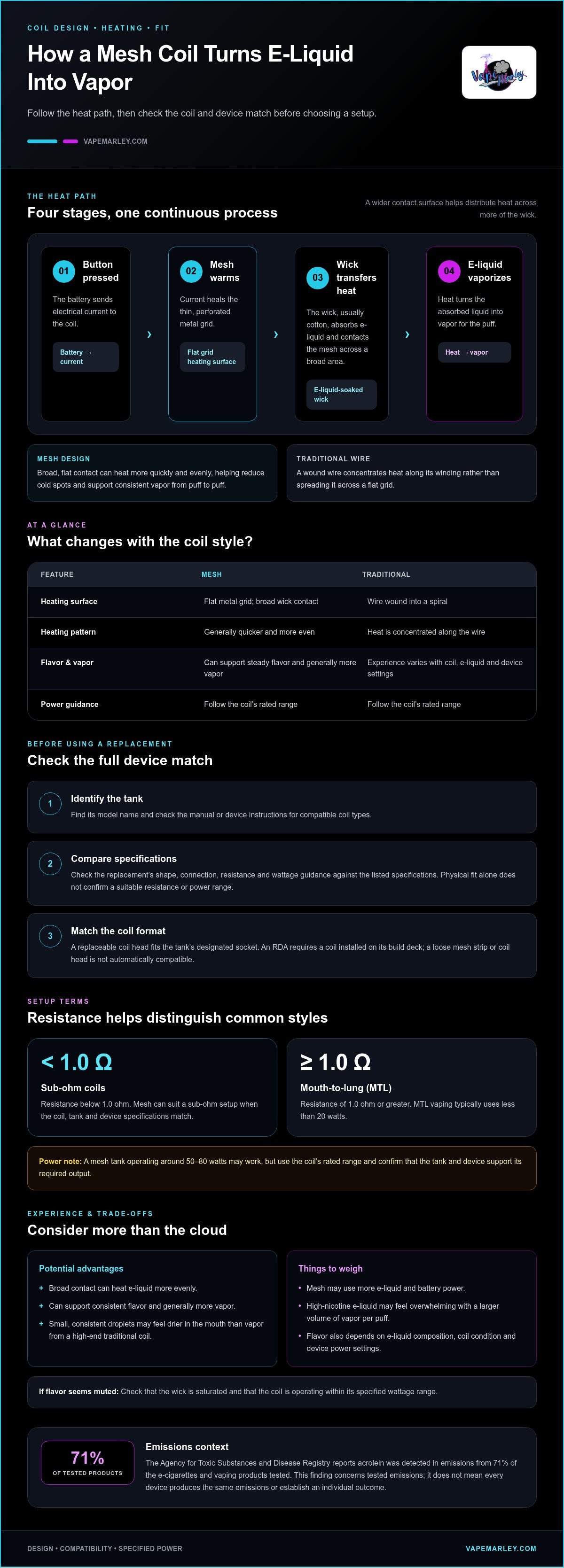
Pressing the device button sends current from the battery to the coil. The mesh heats the wick, which has absorbed e-liquid, and the liquid vaporizes. Because current spreads across the mesh’s wider surface, heating is generally quicker and more even than with traditional wound wire.
Even heating can reduce cold spots and help keep vapor production consistent from puff to puff. But mesh coils don’t all use the same power. Pair a mesh coil with a tank and device designed to support its required output, and follow the wattage range printed on the coil.
| Coil option | Heating surface | Flavor and vapor | Power guidance |
|---|---|---|---|
| Mesh | Flat metal grid | Even heating; generally more vapor | Use the coil’s rated range |
| Traditional | Wound wire | Heat is concentrated along the wire | Use the coil’s rated range |
Choose mesh for even heating and stronger vapor production, but choose based on device compatibility and the coil’s rating, not appearance alone.
Vaping also carries exposure risks beyond coil design. The Agency for Toxic Substances and Disease Registry reports that acrolein was detected in emissions from 71% of the e-cigarettes and vaping products tested. That finding concerns tested emissions; it doesn’t mean every device produces the same emissions or establish an individual outcome.
What are vape coils and how do they work?
Vape coils turn electrical energy into heat, vaporizing e-liquid absorbed by a wick. Their shape, resistance, and fit determine how they work in a particular tank and vaping style.
Mesh Coils
A mesh coil uses a thin, perforated metal strip shaped like a grid. The battery sends current through the mesh, heating the e-liquid held in the wick. Its broad surface touches more of the wick than a narrow wire does, distributing heat across that area. This design can heat liquid quickly and evenly.
For example, a mesh coil can suit a sub-ohm setup, which has resistance below 1.0 ohm. The coil’s resistance and rated power still need to match the device and tank.
Traditional Wire Coils
A traditional coil is wire wound into a spiral around or beside a cotton wick. When the user presses the button, current heats the wire, the wick draws in e-liquid, and the heat turns it into vapor. Unlike mesh, the wire concentrates heat along its winding rather than across a flat grid.
Wire coils can be made smaller than mesh coils, which helps explain their use in small pod mods. The right choice depends on the tank’s design, compatible coil format, and the vaping experience you want.
Mesh Coils in Different Vaping Styles
Resistance helps distinguish common setups. Sub-ohm coils have resistance below 1.0 ohm, while mouth-to-lung (MTL) coils have resistance of 1.0 ohm or greater. MTL vaping typically uses less than 20 watts. Match the coil’s design and power needs to the device, rather than assuming every mesh coil suits every style.
Mesh coils can also be used in rebuildable dripping atomizers (RDAs), where users install a coil and apply e-liquid to the wick. Traditional wire is another build option. The atomizer’s build deck and the user’s device determine which coil configuration fits.
Before buying a replacement coil, find your tank’s model name and check its manual or the device instructions for compatible coil types. Compare the replacement’s shape, connection, resistance, and wattage guidance with the listed specifications. A coil may fit physically but still have an unsuitable resistance or power range.
Check how the tank holds its coil, too. A replaceable coil head fits into the tank’s designated socket, while an RDA requires a coil installed on its build deck. These are different formats, so a loose mesh strip or coil head isn’t automatically compatible with a tank or atomizer.
Mesh coil construction
A mesh coil combines a thin metal grid with a wick, usually cotton. Its material, resistance, and number of mesh layers affect how it heats e-liquid and fits a device.
Single-Mesh Construction
A single-mesh coil uses one perforated metal strip as its heating element. The grid curves around or sits against cotton, giving the wick a broad contact surface. Common mesh materials include Kanthal and Nichrome. As current passes through the strip, the metal heats and transfers energy across the e-liquid-soaked cotton.
Some single-mesh sub-ohm coils have resistance around 0.15 ohms. Higher-resistance mesh coils for mouth-to-lung use commonly range from 0.8 to 1.2 ohms. Resistance affects the coil’s electrical behavior, so the device’s supported range and the coil’s rated wattage matter when choosing a replacement.
For installation, use a coil made for the tank and seat it as its design requires. Add e-liquid to visible cotton before filling the tank, then wait 10 to 15 minutes so the wick can absorb liquid. This reduces the risk of firing a dry wick and damaging the coil.
Dual-Mesh Construction
A dual-mesh coil contains two mesh heating elements rather than one. Both elements heat e-liquid through the wick, increasing the total heating surface compared with a single-mesh design. Many dual-mesh coil heads have resistance around 0.2 ohms, so they are commonly associated with sub-ohm setups.
The added surface affects the coil’s power needs and vapor output. Use the wattage range printed on the coil or supplied with its device, rather than assuming dual mesh works like a single-mesh replacement. A suitable tank and compatible device are essential because coil heads vary in size, connection, and electrical resistance.
Dual mesh isn’t the only alternative to a single grid. Ceramic coils use porous ceramic as a wick or around a wire, and the ceramic absorbs e-liquid. Compared with mesh, ceramic coils are described as slower to heat and as producing less vapor, while offering long-lasting, consistent flavor. The material and heating design affect both performance and the pace of a vaping session.
Whether installing single or dual mesh, saturate the wick before use and follow the coil’s instructions. After filling, allow the stated absorption time, then start within the coil’s recommended power range. If the tank or coil specifies a different priming procedure, follow the instructions for that hardware.
Coil heat-up time and lifespan
Mesh coils heat e-liquid across a broad surface, helping them ramp up quickly and evenly. Coil life is less predictable: e-liquid, wattage, and vaping frequency all affect how long the wick and heating surface perform before replacement.
A typical vape coil lasts about 1-2 weeks, but that range is a guide, not a schedule. Heavy vaping can mean replacing a mesh coil every 5 days, while light use may let one last three weeks or more. The difference comes from how often the coil heats and how consistently its cotton wick stays saturated.
Coil construction matters, too. Dual-, triple-, and quad-core coils may last around a week of regular use before replacement. Mesh coils often last longer than traditional coils, but frequent puffs, high wattage, and residue-producing e-liquid can shorten their lifespan. A coil’s wider surface affects heating, not its resistance to wear.
Replace a coil when its performance noticeably changes. A burnt taste, weaker flavor, or reduced vapor can signal that the wick or heating element isn’t performing as expected. Don’t raise the wattage to compensate. Check the coil’s rated range and replace it if poor performance continues within that range.
To help a new mesh coil last, prime it before use. Apply e-liquid to the visible cotton, fill the tank, then wait 10 to 15 minutes for absorption. Keep the tank supplied with liquid and leave a few seconds between puffs so the wick can re-saturate. These steps reduce dry heating that can damage cotton early.
Vaping frequency and nicotine strength affect use patterns, but nicotine doesn’t determine a guaranteed coil lifespan. Someone taking frequent puffs may need to replace a coil sooner than someone using the same coil occasionally. Track the coil’s taste and vapor output over time instead of replacing it just because a certain number of days has passed.
In the United States, replacement mesh coil prices vary by model, pack size, and retailer. Compare the cost per coil and make sure the replacement matches your tank before buying.
Mesh coil advantages and disadvantages
Mesh coils trade even heating for higher e-liquid and battery use. Whether that trade-off is worthwhile depends on your device, preferred draw, and how you value flavor, vapor, and battery life.
Where Mesh Coils Stand Out
A flat mesh heating surface distributes current across the wick, which can help reduce hot spots. The design ramps up quickly, often produces strong flavor and substantial clouds, and can provide a cooler vape than multi-core coils. Its flat profile can also help prevent popping and spitting, making each puff feel smoother.
Mesh can also be efficient compared with a dual coil of the same resistance. It generally requires less power, and a single-battery device may produce a similar volume of vapor to a wound coil at a lower operating wattage. That difference can be useful if you want fuller vapor without moving to a larger device.
What You Give Up
Producing more vapor can use more e-liquid and battery power, depending on the setup. The wattage setting matters: vaping at 70 watts instead of 50 watts draws about 40% more power. That increase can shorten battery life during a session, even when the mesh coil heats efficiently.
High output may not suit every setup or preference. High-nicotine e-liquid can feel overwhelming when a coil produces larger clouds. Results also depend on the device and coil rating, so greater vapor production isn’t automatically an upgrade.
Mesh isn’t always the simplest choice for compact hardware. Standard wire coils can be made smaller, which helps explain their use in small pod mods. A mesh coil must fit the tank, and its wattage needs to match the device. Materials such as Kanthal describe the heating element, but material alone doesn’t determine compatibility or performance.
A Practical Decision Guide
| Priority | Mesh coil fit | Trade-off |
|---|---|---|
| Even heating and quick ramp-up | Strong match | More e-liquid use |
| Lower battery demand | Can suit single-battery devices | Output still depends on wattage |
| Compact pod hardware | Check tank compatibility | Wire coils can be smaller |
| Large vapor clouds | Often a good match | May increase nicotine delivery per puff |
Choose mesh if even heating and fuller vapor matter more than conserving liquid and battery; prioritize device fit and the coil’s rated wattage. For vaping accessories that complement your setup, browse vape accessories.
VapeMarley: Disposable Vapes
VapeMarley offers disposable vapes, vape accessories, and vape bundles for readers considering what to use next. If comparing coil construction has clarified the features you want, a disposable vape may suit you if you prefer a ready-to-use device over choosing a separate tank and replacement coil. Vape accessories and bundles are also available if you want to explore products individually or together.
Coil type matters for refillable devices, while a disposable vape offers a different product format. Keep that distinction in mind as you decide what fits your preferences. Visit vapemarley.com to explore VapeMarley’s offerings or get in touch.
Make Your Next Vape Choice With Confidence
Understanding what a mesh coil in a vape is can help you judge device descriptions: first decide what kind of experience you want, then look for a setup designed to match. Consider what matters most, such as a ready-to-use format or the flexibility to select accessories separately. That preference can make product comparisons more useful than a feature list alone.
If you’re ready to explore your options, VapeMarley can help you consider a suitable next step. Contact VapeMarley for help choosing and move forward with a choice that fits your preferences.
Frequently Asked Questions
What Is a Mesh Coil Made Of?
A mesh coil combines a perforated metal heating element with a wick, usually cotton. The metal grid may use materials such as Kanthal or Nichrome, while cotton holds e-liquid beside the heating surface. For example, a replacement coil head contains these parts inside a housing designed for a particular tank. Check the coil packaging or device instructions for material and compatibility details before installing it.
Understanding the Basics: What Is a Vape Coil?
A vape coil heats e-liquid so it can become an inhalable aerosol. It works with a wick, which draws liquid toward the heated element. In a refillable device, the coil sits inside the tank or atomizer and connects to the battery. If a device stops producing vapor or tastes burnt, the coil and wick are among the parts to inspect.
What Is Mesh, and How Is It Different From Standard Coiled Wire?
Mesh is a thin metal sheet with openings that form a grid, rather than wire wound into a spiral. This changes the heating element’s shape and how much wick it contacts. In practice, mesh coil heads and round-wire heads aren’t automatically interchangeable. Use the coil type specified for the tank, even if another coil looks similar or has a matching connection.
What Is a Mesh Coil in a Vape, and How Does It Work?
A mesh coil in a vape uses a metal grid to heat e-liquid held in the wick. When the device is activated, the battery supplies current; the warmed wick then releases vaporized liquid through the airflow path. For example, if the tank’s airflow is closed or the wick is dry, the draw may feel different even when the coil is working. The tank and coil function as a system.
What Materials Are Mesh Vape Coils Made From?
Mesh heating strips are often made from Kanthal or Nichrome, while the wick is commonly cotton. These materials serve different roles: metal conducts current and heats up, while cotton absorbs e-liquid and brings it near the heating element. Ceramic is another coil-related material, but ceramic designs use porous ceramic as a wick or around wire. Check the device or coil documentation to identify its construction.
How Does a Mesh Coil Differ From a Traditional Round-Wire Coil?
A mesh coil uses a flat grid, while a traditional round-wire coil uses wire formed into a winding. The geometry affects wick contact and heat distribution, but doesn’t determine tank compatibility by itself. For example, a coil with the right resistance may still have the wrong shape or connection for a particular tank. Match the replacement to the device’s specified coil type and model.
What Are the Drawbacks of Mesh Vape Coils?
Mesh coils can use more e-liquid and battery power than regular coils, particularly when producing more vapor. Their nicotine delivery per puff may also feel strong if the e-liquid has high nicotine strength. Compatibility is another practical limitation: a mesh replacement must fit the tank and work within the device’s supported wattage. If conserving e-liquid or battery power matters most, weigh those trade-offs before choosing a setup.
How Long Does a Mesh Vape Coil Typically Last?
A typical vape coil lasts about 1-2 weeks, though use can shift that timeframe. Heavy vaping may mean replacing a mesh coil every 5 days, while light use may extend its life to three weeks or more. E-liquid, wattage, and puff frequency all contribute. Replace the coil when a burnt taste, reduced vapor, or persistent flavor change signals declining performance, rather than relying on a calendar date alone.