
What are the common components of an e-cigarette?
Posted by Silar on Nov 18th 2026
A disposable vape may look like a single piece, but an e-cigarette contains several components. A battery powers a heating element, which warms e-liquid into an aerosol for inhalation. The liquid commonly contains nicotine, propylene glycol, flavorings, and other chemicals.
It’s natural to wonder what’s inside a device designed to be simple and ready to use. The details matter: ingredients can vary, and a “nicotine-free” label doesn’t always rule out trace nicotine. Disposable e-cigarettes also differ from reusable devices because their components are integrated.
This guide explains the main components of disposable devices and how they work. It also covers differences in U.S. e-liquid manufacturing standards, potential health effects associated with vaping, and how vaping relates to quitting tobacco. Understanding what an e-cigarette contains can help you assess its design and the questions worth considering.
Key Takeaways
- Identify how a battery, heating element, liquid, and mouthpiece work together to create an inhaled aerosol.
- Understand what makes disposable devices different and how their design affects the way they’re used.
- Learn why ingredients and aerosol exposure matter when considering possible lung and brain health effects.
- See what research says about vaping and quitting tobacco, and why quit-rate evidence is different from FDA approval.
- Use the guide’s comparisons to understand device types and explore VapeMarley’s disposable vapes, accessories, and bundles.
Potential lung and brain health effects
Vaping can expose users to nicotine and chemicals in inhaled aerosol. The effects depend partly on a device’s contents, making its ingredients one factor to consider.
Potential Lung Effects
Potential lung effects include exposure to particles and chemicals carried in aerosol. Ultrafine particles can travel deep into the lungs, while acrolein can cause irreversible lung damage. Diacetyl is linked to bronchiolitis obliterans, also called popcorn lung. Diethylene glycol, a toxic chemical used in antifreeze, is linked to lung disease. These examples show why an e-cigarette’s contents matter, not just its flavor.
Potential Brain Effects
Nicotine is highly addictive and negatively affects adolescent brain development. That matters because repeated exposure can make quitting difficult, even when someone wants to stop. In 2024, 5.9% of U.S. middle and high school students, or 1.63 million students, currently used e-cigarettes, according to the Centers for Disease Control and Prevention. Some products labeled nicotine-free can contain trace nicotine, so the label alone may not tell the full story.
Health Risks Compared With Smoking
Comparing vaping with smoking doesn’t make either option risk-free. Heating e-liquid can form additional toxic chemicals, including acetaldehyde and formaldehyde, which are carcinogens found in vaping products. E-cigarettes have also been found to contain heavy metals such as nickel, tin, and lead. These examples show why aerosol exposure deserves attention, even when a device differs from a traditional cigarette.
Health concerns also include reports of serious lung illness associated with vaping. In 2019, many reports described serious lung disease among people using e-cigarettes or other vaping devices. That episode illustrates why product contents and source can matter. A disposable format may simplify use, but convenience doesn’t remove the need to understand potential exposure.
For age restrictions, federal law prohibits selling any tobacco product, including e-cigarettes, to people younger than 21 years of age, according to the U.S. Congress. Federal regulation also covers these products, including nicotine from any source. This nationwide age rule applies to retail sales; it doesn’t make nicotine exposure safe for younger people.
State and local rules can add restrictions on sales or public vaping. As of March 31, 2023, seven U.S. states had restricted sales of flavored tobacco products. As of April 2017, 12 states and 615 localities had prohibited vaping in venues where traditional cigarette smoking was prohibited. The location and date matter when determining which restrictions apply.
There isn’t one retail price for every device or e-liquid. The cost depends on the product format, whether liquid is included, and whether the device is disposable or refillable. These differences affect what a customer buys, but price alone says nothing about an e-cigarette’s ingredients or health effects.
Disposable e-cigarettes
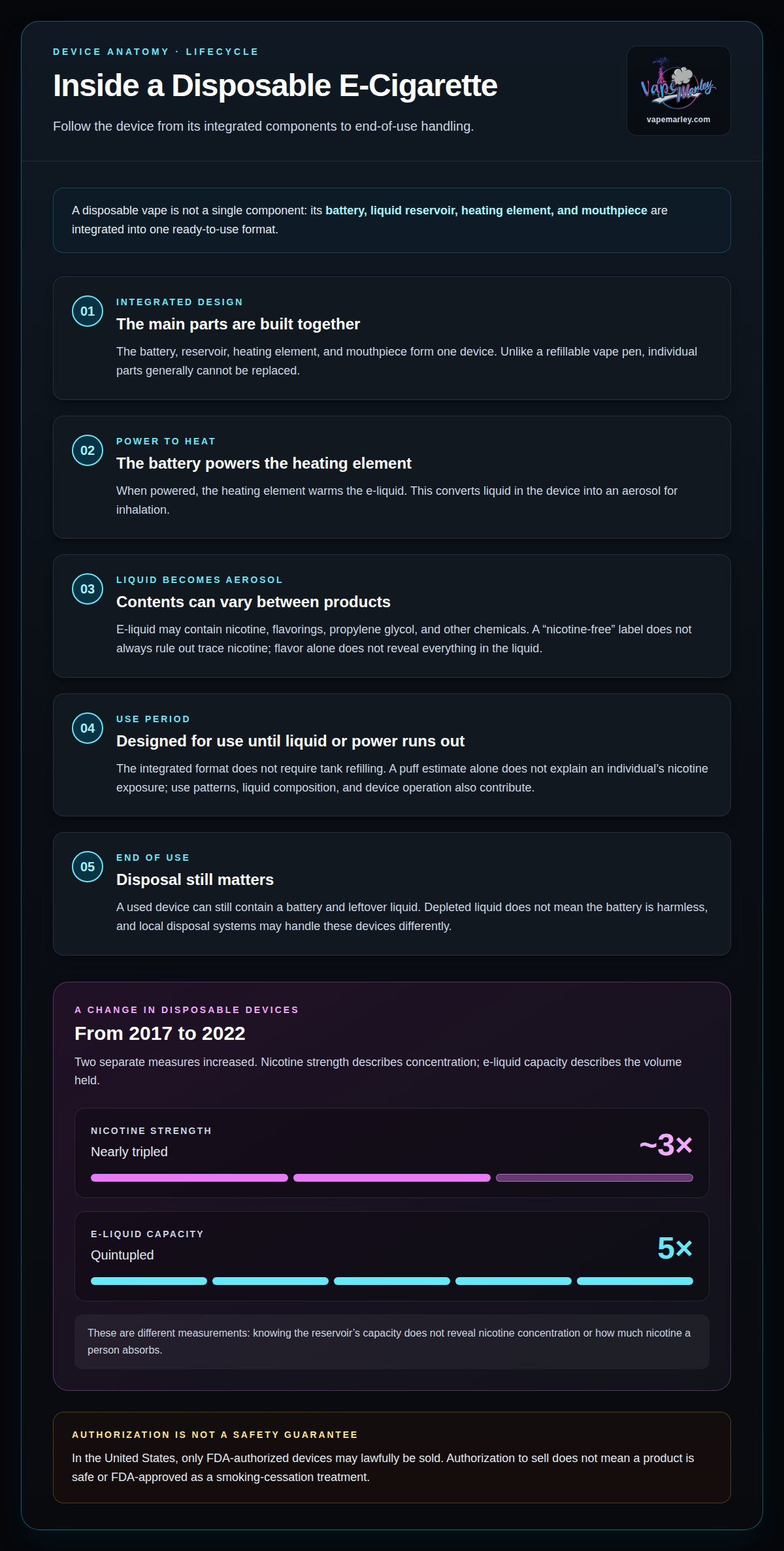
A disposable device combines its battery, liquid reservoir, heating element, and mouthpiece in one ready-to-use format. Unlike a refillable vape pen, it’s designed to be used until its liquid or power runs out, then discarded. This integrated construction simplifies setup, but users generally can’t replace individual parts. “Disposable” describes the device format, not its ingredients or health effects.
Inside, the battery powers a heating element that warms the liquid into inhalable aerosol. The liquid may contain nicotine, flavorings, propylene glycol, and other chemicals. Nicotine is addictive, and a disposable e-cigarette can deliver it without requiring users to refill a tank. Flavors affect taste, but they don’t reveal what else the liquid contains or make the aerosol harmless.
Disposable devices changed notably between 2017 and 2022. During that period, their nicotine strength nearly tripled, while e-liquid capacity quintupled. These are separate measures: strength refers to nicotine concentration, while capacity describes the volume of liquid held. Knowing one doesn’t reveal the other. A larger reservoir, for example, doesn’t by itself indicate nicotine concentration or the amount absorbed during use.
A puff estimate alone doesn’t explain an individual’s nicotine exposure. Use patterns, liquid composition, and device operation all contribute. Two devices with similar shapes may differ in their contents or nicotine strength. When comparing an e-cigarette with another vaping format, consider whether the liquid is integrated or refillable and what the product label says.
In the United States, only FDA-authorized devices may lawfully be sold. Authorization to sell doesn’t mean a product is safe or FDA-approved as a smoking-cessation treatment. The FDA’s regulatory role also doesn’t mean every product or ingredient has been reviewed. A familiar format or flavor isn’t evidence of authorization, and authorization itself isn’t a safety guarantee.
Disposal is part of the format. A used device can still contain a battery and leftover liquid, so it isn’t simply an empty bottle or ordinary pen. Don’t assume that depleted liquid means the battery is harmless, or that every local disposal system handles these devices alike. Convenience comes from the integrated design, but the battery, contents, and end-of-use handling remain relevant considerations.
E-cigarettes and tobacco cessation
Some adults consider vaping as an alternative to tobacco products when trying to quit smoking. Evidence about quit rates is relevant, but it doesn’t make every device a proven cessation treatment or remove its health risks.
A 2022 meta-analysis of 61 studies found, with high certainty, that people using nicotine e-cigarettes had higher quit rates than people randomized to nicotine replacement therapy. Nicotine replacement includes options such as patches and gum, which deliver nicotine without inhaling vaping aerosol. That finding compares study outcomes; it doesn’t mean every person will quit more easily with a vape.
The comparison also has limits. A product’s nicotine delivery, a person’s tobacco use, and how consistently they use a quitting aid can shape the experience. Cigarettes and vaping products may differ in nicotine content and other chemicals, so a result for one type of aid doesn’t predict an individual outcome. The FDA has not approved any e-cigarette product for quitting smoking.
For someone considering quitting, the practical first step is to define the goal: stopping combustible tobacco, stopping all nicotine, or both. Those goals aren’t identical. Someone who switches from cigarettes to vaping may still use nicotine, which can remain addictive. Setting a clear goal helps distinguish changing products from quitting completely.
Someone who wants to quit vaping can start by noting when they reach for a device, such as after meals, during a work break, or while driving. Next, they can choose a quit date, remove devices and supplies from everyday routines, and plan a substitute activity for those moments. If withdrawal or cravings make the plan difficult, a healthcare professional can discuss support and suitable quitting aids.
It also helps not to treat a lapse as the end of a quit attempt. If someone uses a vape after stopping, they can identify the trigger, adjust their plan, and resume their goal. For example, someone who vapes during stressful breaks might plan a short walk or another routine instead. Progress toward the stated goal matters more than simply changing brands or flavors.
Quitting tobacco and quitting vaping can involve different products, habits, and nicotine exposure. Nicotine patches or gum may suit someone who wants to avoid inhaling aerosol, while research has found higher quit rates for nicotine vaping than for nicotine replacement in the analyzed studies. Weigh that comparison alongside the FDA’s lack of approval for vaping products as smoking-cessation treatments. A considered plan makes clear which product is being stopped, which triggers need attention, and what support may help maintain the change.
What are the different types of e-cigarettes and vaping devices?
Vaping devices are often grouped by their shape, liquid system, and level of user control. Cigalikes, vape pens, pod systems, and box-style devices are common formats, but their names alone don’t reveal the ingredients or nicotine exposure.
Cigalikes
Cigalikes are compact devices shaped to resemble traditional cigarettes. Their familiar form distinguishes them from larger vape pens, but appearance doesn’t show how a device works internally. Some use replaceable cartridges, while other designs integrate the liquid section. The key difference is how the liquid is held and replaced, not the cigarette-like shape. As with any format, the liquid may contain nicotine.
Vape Pens
Vape pens have a narrow, pen-like body and are generally designed around a battery and a liquid-holding component. Their shape makes them easy to distinguish from box-style devices. Depending on the design, the liquid section may be replaceable or refillable. That distinction affects how users replenish the liquid, but doesn’t reveal the ingredients, nicotine strength, or health effects of the aerosol.
Pod Systems
Pod systems use a pod to hold e-liquid, paired with a powered device that heats it. Depending on its design, a pod may be replaceable or refillable. This format separates the liquid container from the main body more clearly than an all-in-one disposable. “Pod” identifies the format, not a specific nicotine level or ingredient list. Check the product label and device details for those.
Box-Style Devices
Box-style devices have a broader body than cigalikes and vape pens. Their larger shape is a visual category, not proof of a particular battery capacity, output, or safety level. Some designs allow more user adjustment, while others keep operation simpler. Compare the actual controls and liquid system rather than assuming every box-style model has the same features.
These categories describe form and operation, not health rankings. For a practical comparison, look at four points: whether the liquid container is integrated, replaceable, or refillable; how the device is powered; whether settings can be adjusted; and whether the product’s contents are disclosed. For example, a refillable pod and a cartridge-based cigalike differ in how users replenish liquid, even though both are compact.
Regulatory status is separate from device type. In the United States, only FDA-authorized e-cigarettes may lawfully be sold. Authorization to sell doesn’t mean a product is safe or FDA-approved for quitting smoking. The FDA list includes 48 authorized devices, so a familiar category name alone does not establish authorization. Understanding the format helps describe a device; it doesn’t replace checking its ingredients and regulatory status.
Are e-cigarettes safer than smoking traditional cigarettes?
A simple “safer” label can obscure important differences between products and exposures. Vaping avoids burning tobacco, but its aerosol can still contain harmful substances. The available facts support a careful comparison, not a claim that either option is safe.
Heating e-liquid can form additional toxic chemicals, including acetaldehyde and formaldehyde, which are carcinogens found in vaping products. E-cigarettes have also been found to contain heavy metals such as nickel, tin, and lead. These findings show that aerosol exposure can involve substances associated with health risks, even when a device doesn’t burn tobacco.
Traditional cigarettes contain harmful substances too. Cadmium, a toxic metal found in traditional cigarettes, can cause breathing problems and disease. This example shows why comparing products requires more than looking at one ingredient or device feature. The presence of a particular chemical doesn’t, by itself, quantify a person’s overall exposure or establish a precise risk ranking.
Product authorization also needs careful interpretation. FDA authorization to sell a device in the United States doesn’t mean the product is safe or FDA-approved. Authorization isn’t a blanket assurance about all potential health effects, and it doesn’t make vaping risk-free. A device’s flavor, form, or convenience likewise can’t establish its safety.
For an adult who currently smokes, the comparison depends on their actual pattern of use. Continuing to smoke while also vaping differs from stopping tobacco smoking entirely. The products, ingredients, and exposure pathways differ, so using both shouldn’t be treated as equivalent to eliminating smoke exposure. For someone who doesn’t use tobacco, starting to vape introduces exposure rather than reducing an existing one.
A practical way to assess the question is to separate three issues: whether tobacco is being burned, what substances the aerosol may contain, and whether the person is using nicotine. Each matters. For example, a nicotine-containing vape may avoid tobacco combustion but still expose the user to addictive nicotine and aerosol chemicals. No single device label answers all three questions.
The bottom line is that vaping and smoking have different exposure profiles, but neither should be described as harmless. If you’re considering a disposable format, explore disposable vape options as a product category, not as a safer-health choice.
VapeMarley
VapeMarley helps readers move from understanding device components to exploring vaping products that suit their preferences. Its selection includes disposable vapes, vape accessories, and vape bundles, offering options to consider after learning how device formats and liquid systems differ.
Use what you’ve learned to focus on practical details, such as whether a device is disposable and what purpose an accessory serves. Product choice doesn’t change the health considerations discussed above, and vaping products shouldn’t be treated as risk-free or as approved smoking-cessation treatments.
If you have questions about VapeMarley’s offerings, contact VapeMarley.
Make your next choice with clarity
Let your next step reflect what you want from a product, not just what looks familiar. For any e-cigarette, separate practical preferences from health or quitting goals. A convenient format doesn’t answer questions about ingredients, nicotine, or exposure. Keeping those decisions distinct can help you make a more informed choice.
If your priority is quitting tobacco or nicotine, focus first on that goal and the support that fits it. If you’re exploring vaping products, use the differences between device types to guide what you want to learn more about. VapeMarley can help you explore its selection, without treating a purchase as health advice or a promise of a particular outcome.
Have a question as you consider your options? Contact VapeMarley with your questions. Take your time, stay informed, and choose your next step with confidence.
Frequently Asked Questions
What's in an E-Cigarette?
Most devices combine a power source, a heating element, a liquid container, and a mouthpiece. Depending on the format, the container may be a built-in reservoir, a replaceable cartridge, or a pod. The liquid can contain nicotine, flavorings, propylene glycol, and other chemicals. To understand a particular product, read its ingredient and nicotine labeling rather than relying on its flavor or shape.
Can e-cigarettes help people quit using tobacco?
Nicotine vaping may help some adults stop smoking, but it isn’t an FDA-approved smoking-cessation treatment. A 2022 meta-analysis of 61 studies found higher quit rates among people using nicotine vaping products than among participants assigned nicotine replacement therapy. That result describes study findings, not a guaranteed outcome. Someone planning to quit can discuss available support and their tobacco and nicotine goals with a healthcare professional.
Is exposure to secondhand e-cigarette aerosol harmful?
Secondhand aerosol isn’t simply clean water vapor. Vaping aerosol can contain particles and chemicals, so people nearby may breathe in some of the same types of substances. The specific exposure depends on the device, liquid, and surrounding conditions. To reduce bystander exposure, avoid vaping around other people, especially children and teens, rather than assuming an odorless cloud contains nothing.
What is vaping?
Vaping means using a powered device to heat a liquid and inhale the resulting aerosol. It doesn’t involve burning tobacco in the same way as smoking a cigarette, but it can still involve nicotine and other chemicals. For example, using a disposable device and using a refillable pod are both forms of vaping, though their liquid containers differ.
What is an e-cigarette and how does it work?
An e-cigarette is a battery-powered device that heats e-liquid into an aerosol for inhalation. When activated, the device sends power to a heating element; the warmed liquid then passes through the mouthpiece as aerosol. The design varies: a disposable may integrate its components, while another model may use a separate pod or cartridge. This describes how it works, not a safety guarantee.
What ingredients are in e-cigarette aerosol and e-liquid?
E-liquid commonly contains nicotine, propylene glycol, flavorings, and other chemicals. Heating it can create additional substances, so aerosol contents aren’t necessarily identical to the liquid’s listed ingredients. Some products labeled nicotine-free can contain trace amounts of nicotine. Checking an ingredient label can help identify listed contents, but it doesn’t establish every substance formed during heating.
What are the health risks of e-cigarettes for adults and teens?
Nicotine is addictive and can negatively affect adolescent brain development. Potential exposure concerns also include ultrafine particles that can reach deep into the lungs, and chemicals such as acrolein and diacetyl are associated with lung risks. Adults and teens shouldn’t treat appealing flavors or a nicotine-free label as proof of harmlessness. Keep vaping products away from children and pets, and avoid starting nicotine use.
Can e-cigarettes help people quit smoking, and what does the evidence show?
Research suggests nicotine vaping can support quitting for some people, but the evidence doesn’t make these products approved cessation medicines. The 2022 meta-analysis reported higher quit rates versus nicotine replacement therapy among its study participants. The FDA has not approved any vaping product for quitting smoking. Anyone considering a quit attempt can clarify whether the goal is ending cigarette use, nicotine use, or both.