

Vape Airflow Explained: Tight vs Loose Draw and How Airflow Works
Posted by Silar on Oct 21st 2026
More airflow isn’t automatically better. To have vape airflow explained clearly, start with what changes: a tighter setting lets less fresh air mix with vapor, creating a warmer, more concentrated draw, while an open setting brings in more air for a cooler, airier cloud. The right balance depends on the draw you prefer and how the device is designed.
It’s reasonable to expect airflow to affect more than cloud size. It can also change how warm a puff feels, how clearly flavor comes through, and how the coil behaves. Airflow is one part of the experience, alongside power, coil resistance, and vaping style.
This guide explains how airflow works, what tight and loose draws feel like, and how airflow interacts with coil temperature and battery use. It also covers why disposable vapes often have preset airflow designed around the device’s e-liquid and power, rather than settings you adjust yourself.
Key Takeaways
- Set your e-liquid, coil, wattage, and vaping style first; then fine-tune airflow to suit the setup.
- Make small airflow changes and take a few puffs before deciding whether the draw feels right.
- Airflow doesn’t use e-liquid by itself; wattage affects how quickly the coil vaporizes it.
- Match your expectations to the device: disposable vapes often have preset airflow designed around their built-in settings.
- For adjustable devices, the airflow ring changes how much air enters through the slots as you rotate it.
What is airflow and what does it do in a vape?
A vape feels airy when more fresh air enters during a draw, and harsh when the vapor feels hot or concentrated. A hard-to-draw vape usually has restricted airflow or an opening blocked by residue.
Airflow controls how much fresh air mixes with vapor as it leaves the coil. On an adjustable tank, a rotating ring covers or uncovers airflow holes, often near the tank’s base. Turning the ring changes the opening, not the e-liquid. Many modern devices have adjustable settings, while others have a fixed draw.
Airflow changes the character of a puff. A wide opening draws in more room-temperature air, cooling the vapor and often creating larger, airier clouds. That extra air can dilute the flavor, making it less distinct. A narrow opening mixes in less air, so the vapor feels warmer and denser. Flavor can seem stronger, and the throat hit firmer, closer to the sensation some users associate with a cigarette.
Airflow also affects the balance between vapor and liquid use. Opening the airflow can increase vapor production, and you may inhale more vapor as a result. Airflow itself doesn’t consume liquid; higher wattage vaporizes e-liquid faster. For example, the same coil can feel cooler with more air, while its power setting still affects how quickly it uses liquid.
Use the symptom to guide a small adjustment. A harsh, hot puff may feel smoother if you open the ring slightly. If flavor seems muted, close it a little to concentrate the vapor. A whistle may come from air passing through a narrow opening; a slight change to the ring can alter that airflow path. If the device spits or gurgles, inspect the airflow holes for residue and clean them if they’re blocked.
- Leaking: Airflow holes don’t cause a tank to leak, but e-liquid can escape through them when a tank leaks. An old, poorly fitted, or oversaturated coil can contribute; using the wrong wattage or leaving airflow wide open at low power can also make leaks more likely.
- Weak flavour: Try a slightly tighter draw, then notice whether flavour intensity improves without making the puff uncomfortably warm.
For a clear explanation of vape airflow, treat the ring as one part of the setup. Coil resistance, wattage, e-liquid, and draw style all influence the result, so a tighter opening won’t create the same experience on every device. Change the setting gradually, then compare warmth, clouds, flavor, and throat hit over several puffs.
Is More Airflow Better for Vaping?
Tight airflow restricts incoming air, while loose airflow lets more air pass through during a draw. Neither setting is universally better. Choose based on whether you prefer a cigarette-like inhale, a balanced draw, or larger clouds.
Tight and Loose Airflow
Tight airflow narrows the opening for a warmer, more concentrated draw. Loose airflow widens it for a cooler, airier inhale. More air can dilute flavor and soften the throat hit, while less air can make both feel stronger. If an open setting feels too airy, close it slightly; if a tight draw feels harsh, open it slightly.
Matching Airflow to Vaping Habits
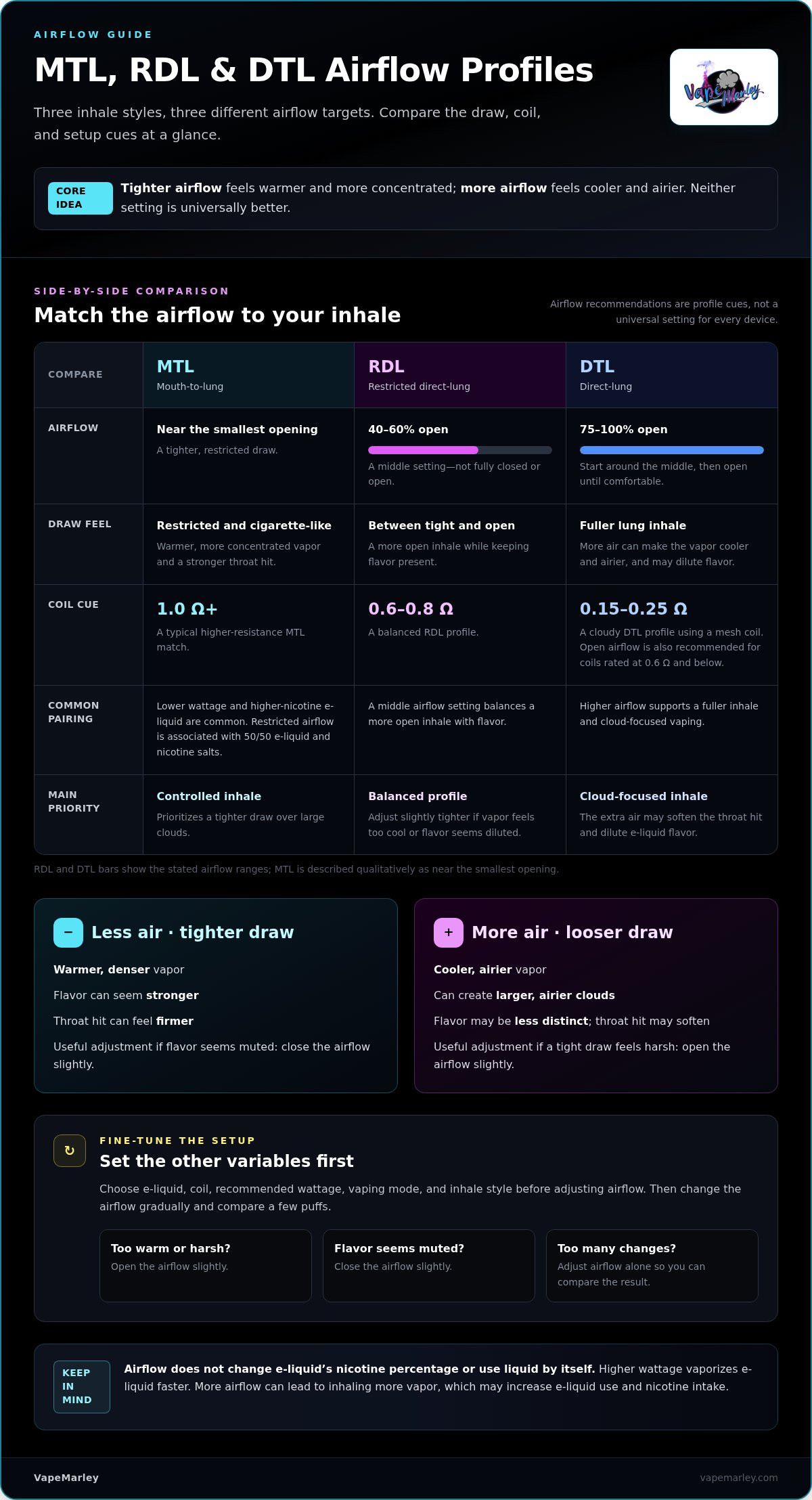
MTL, RDL, and DTL describe different inhale styles, so matching airflow to your style helps shape the draw. MTL means mouth-to-lung, RDL means restricted direct-lung, and DTL means direct-lung. A tighter setting suits the cigarette-like MTL inhale. RDL sits between tighter and open airflow, while DTL typically uses more air for a fuller lung inhale.
For MTL: Set the airflow collar near its smallest opening for a restricted draw and stronger throat hit. MTL commonly pairs higher-resistance coils, lower wattage, and higher-nicotine e-liquid. Coils rated at 1.0 Ω or higher are a typical MTL match, and restricted airflow is associated with 50/50 e-liquid and nicotine salts. This setup prioritizes a controlled inhale over large clouds.
For RDL: Aim for a middle setting rather than fully closing or opening the airflow. A balanced RDL profile uses a 0.6-0.8 Ω coil and airflow 40-60% open. That provides room for a more open inhale while keeping flavour present. If the vapor feels too cool or flavour seems diluted, close the airflow slightly and compare the next few puffs.
For DTL: Start around the middle of the airflow range, then open it until the draw feels comfortable. A cloudy DTL profile uses a 0.15-0.25 Ω mesh coil and airflow 75-100% open. Cloud-focused vaping can use the highest airflow setting, though the extra air may dilute e-liquid flavour. Open airflow is also recommended for low-resistance coils rated at 0.6 Ω and below.
Let your preferred style guide the adjustment: MTL vapers can begin at the smallest setting, while direct-lung vapers can start midway. For cloud chasing, increase airflow toward maximum; for richer flavor, DTL vapers can reduce it slightly. More airflow can lead to inhaling more vapor, which may increase e-liquid use and nicotine intake. Airflow doesn’t change the e-liquid’s nicotine percentage.
Adjusting airflow after other vape settings
For stronger flavor, close the airflow opening slightly; for a smoother, cooler hit, open it slightly. Set the e-liquid, device, coil, wattage, vaping mode, and inhale style first, then fine-tune the airflow.
That order matters because airflow works alongside the rest of the setup. A coil and wattage combination that produces warm vapor can feel different when you increase the air entering the device. Changing several settings at once makes it harder to tell what caused the difference.
Start with an e-liquid and coil combination suited to your device, then use the wattage recommended for that coil. Next, choose your vaping style and mode. Once those settings are in place, set airflow near the middle of its range. A halfway-open setting leaves room to move toward a tighter or more open draw.
On vape tanks and pod cartridges with adjustable airflow, a control ring or slider changes how much air enters during a puff. Rotate the ring to open or close the slots. Vape pens, box mods, and pod devices may have adjustable airflow, but controls vary by model. Identify the airflow opening before adjusting it.
Test each change with two to three puffs, focusing on one sensation at a time. If flavor feels weak, close the airflow a little and assess its intensity. If the draw feels harsh, open it slightly to let in more air. If the vapor becomes too cool or airy, reverse the change slightly. Small adjustments make comparisons clearer than moving straight from fully closed to fully open.
- For a flavour-focused draw: Keep the coil and wattage steady, then close the airflow slightly. Check whether flavour becomes more concentrated without making the inhale too warm.
- For a smoother hit: Open the airflow a little. More incoming air can cool the vapor and soften a harsh-feeling draw.
- For a changing setup: Reassess airflow after changing the e-liquid, coil, or wattage. Each can alter how the same opening feels.
Adjustable airflow is most useful when you want to refine the draw without replacing the rest of your setup. A fixed-airflow device has no ring or slider to tune, so its draw is determined by its built-in design. With an adjustable tank, you can return to a preferred opening after testing different settings.
Keep a simple comparison: note whether the airflow was tighter or looser, and whether the result felt warmer, cooler, smoother, or more flavorful. This makes it easier to find a comfortable setting when you use the same device and coil again.
Airflow, coil temperature, and battery life
Coil resistance and wattage determine how the coil heats; airflow changes how much air cools it during an inhale. Restricting airflow makes vapor warmer, but airflow alone doesn’t establish whether a device is overheating or unsafe.
Airflow and Vapor Temperature
Airflow affects vapor temperature by changing how much fresh air passes the heated coil and mixes with the vapor. A more open setting cools the coil and vapor; a restricted setting leaves the vapor warmer and more concentrated. This matters if an inhale feels too hot or too cool. Compare settings while keeping wattage and coil unchanged, so airflow is the only adjustment you’re assessing.
Coil resistance and wattage work together: the coil’s resistance and the device’s power setting shape how it heats, while incoming air affects cooling. Use the wattage range intended for the coil, then tune airflow around that setup. For example, a high-resistance coil is associated with restricted airflow, while an open draw suits lower-resistance coils. Airflow can’t correct a mismatched power setting.
Restricted Airflow and Overheating
Restricted airflow reduces cooling and produces warmer vapor, which can make a hot-feeling draw more noticeable. That doesn’t mean a tight setting alone proves the device is overheating. Treat heat as a cue to assess the complete setup, including coil resistance, wattage, and airflow, rather than relying on airflow as a safety control.
Follow the coil and device instructions for wattage, and avoid using a power setting that doesn’t suit the coil. If a draw feels unusually hot, stop changing several settings at once. Return to the recommended power range, then make a small airflow adjustment and compare the next inhale. Opening the airflow may cool the draw, but it doesn’t replace using compatible settings.
Airflow relates to battery life differently than wattage does. Airflow itself doesn’t consume e-liquid, and opening or closing a vent doesn’t directly set the device’s power output. Higher wattage vaporizes e-liquid faster, while battery use follows the device’s electrical demand during each puff. Longer or more frequent use can therefore matter more than the airflow opening alone.
For a practical comparison, keep the device, coil, and wattage the same while testing airflow settings. If the battery seems to drain faster after you change airflow, consider whether your inhale pattern or power setting also changed. A more open draw may encourage longer inhales for some styles, but airflow isn’t a battery-life control. Separate those factors before deciding what changed.
- Warmer vapor: Restricting airflow reduces cooling around the coil.
- Cooler vapor: Opening airflow lets more air pass the coil and mix with vapor.
- Battery use: Keep wattage and puff pattern in view; airflow alone doesn’t determine power demand.
Preset airflow in disposable vapes
Disposable vapes often use preset airflow designed to complement their e-liquid, power, and other built-in settings. Rather than turning a tank ring to change the opening, you use the draw the device was designed to provide. Preset airflow is therefore a key part of the experience, not a separate setting to tune with each inhale.
Airflow works with the coil and power inside the device. Together, these elements shape how much air mixes with vapor, how warm the inhale feels, and how concentrated the draw seems. A restricted preset can feel tighter and warmer; a more open preset can feel airier and cooler. These are general effects, not a guarantee that every device will taste or feel the same.
The practical difference is control. With adjustable airflow, you can change the opening to suit your preferred draw. With a preset design, the airflow stays as built, so you can’t make a tight draw looser by turning a ring. The draw may feel too airy or restricted, and a preset design may leave no separate airflow setting to fine-tune.
When comparing disposable devices, consider your preferred draw alongside the overall vaping experience. Someone who wants a restricted inhale may find an airier draw less satisfying, while someone who prefers a looser inhale may find a tightly restricted design uncomfortable. Flavor and vapor temperature also depend on the device’s e-liquid and power, so airflow alone doesn’t explain every difference between devices.
To assess a preset draw, notice three things during ordinary use: how much effort the inhale takes, whether the vapor feels warmer or cooler, and whether the flavor feels concentrated or diluted. These observations describe the airflow experience without assuming the device is adjustable. If the draw doesn’t suit your preference, changing your inhale technique won’t change the device’s built-in opening.
Preset airflow can suit people who want a simple device without a separate control to manage. Adjustable airflow is more useful if you want to experiment with different draw styles or switch between tighter and looser inhales. Neither approach is automatically better; the difference is whether you prefer a fixed design or control over the airflow setting.
Disposable vapes are one option for a ready-to-use format, while an adjustable device gives you more control over airflow settings. Explore disposable vape options if a preset draw fits your preferences.
VapeMarley: Disposable Vapes
VapeMarley offers disposable vapes for readers who prefer a ready-to-use device with preset airflow. Since airflow is built into each design, consider whether you prefer a tighter or airier draw before choosing a disposable. Your preferred draw can help guide the experience you’re looking for, alongside the device’s e-liquid and power.
VapeMarley also offers vape accessories and bundles for readers exploring related options. These offerings suit different shopping needs, but they don’t change a disposable device’s airflow settings. A disposable vape may suit someone who values a fixed, straightforward draw; an adjustable device is better for someone who wants to change the airflow themselves.
Visit VapeMarley to explore disposable vapes.
Choose Your Next Vape with Confidence
Use what you’ve learned about airflow to decide which kind of vaping experience suits your preferences. A practical understanding of vape airflow can help you weigh what matters in your next choice, whether that’s a familiar draw or a device designed for a different style. Your preference is a useful starting point, not a reason to treat one setting as universally best.
VapeMarley offers disposable vapes, vape accessories, and vape bundles to explore as you consider what fits your needs. If you’re deciding whether a preset draw suits you, or have questions about airflow and device choices, contact VapeMarley for help.
Contact VapeMarley with your airflow questions, and take your next step with a clearer sense of what you prefer.
Frequently Asked Questions
What’s the difference between fixed and adjustable airflow?
Fixed airflow has a built-in opening you can’t tune, while adjustable airflow lets you change how much air enters. Disposable vapes often use preset airflow, making the draw part of the device’s design. An adjustable tank may have a rotating ring. Choose based on whether you prefer a set draw or want to experiment with tighter and looser settings.
Does More Airflow Use More Juice?
Airflow itself doesn’t consume e-liquid, but a more open draw may lead you to inhale more vapor and use more liquid. Wattage has a direct role: higher power vaporizes e-liquid faster. If your liquid seems to run down sooner after opening the airflow, compare your puff length and frequency, too. Changes in inhaling habits can affect consumption even when the power setting stays the same.
How does airflow work in a vape?
Air enters through openings in the device, passes toward the coil, and mixes with vapor as you inhale. In Vape Airflow Explained, this is the key mechanism: incoming air joins the vapor on its path through the device. An adjustable tank ring covers or uncovers slots. If a draw suddenly feels restricted, look for residue blocking an opening, especially if the device also gurgles.
What do airflow control settings change in vapor production and flavor?
Airflow settings change how much fresh air mixes with vapor, affecting the draw and flavor. A practical takeaway from Vape Airflow Explained is to keep the device and power setting steady while testing a small airflow change. Take a few puffs and notice whether the vapor feels cooler or warmer, and whether the flavor seems clearer or more diluted. This helps separate airflow’s effect from other adjustments.
How does airflow affect MTL, RDL, and DTL vaping?
Airflow helps match the draw to each inhale style. With MTL, vapor enters the mouth before you inhale, so a tighter opening generally suits its restricted feel. RDL uses a more open but still restricted direct-lung draw. DTL draws vapor directly into the lungs and typically uses a more open setting. If you change styles, adjust airflow to suit your draw rather than copying another setup.
How can I fix leaking, gurgling, or spitback caused by airflow?
Airflow holes don’t cause a tank to leak, but e-liquid can escape through them if the tank leaks. If the device gurgles or spits, inspect the airflow openings and clean away residue if they’re blocked. Also consider whether the coil is old, fitted incorrectly, or oversaturated. Using the wrong wattage for the coil or leaving airflow wide open at low power can make leaking more likely.
What are the airflow differences between pod vapes, tanks, and disposable vapes?
Airflow controls can appear on tanks and pod cartridges, but their placement and adjustment method depend on the device. A tank may use a ring, while a pod’s control may be built into its cartridge. Disposable vapes often have preset airflow designed around their e-liquid and power. Before trying to adjust a device, identify whether it has a control or a fixed draw.