
Menthol Ice vs. Dessert Vape Flavors
Posted by Silar on Nov 26th 2026
Menthol feels cool and crisp, while dessert vape flavors lean sweet, rich, and layered. In a menthol vs. dessert comparison, the main difference is the sensation and flavor profile: menthol brings a cooling edge, while dessert blends evoke treats such as creamy or baked sweets. “Ice” can signal cooling without necessarily adding mint.
If you’re wondering what menthol tastes like, it can feel cool and sometimes minty, although menthol itself isn’t the same as mint flavor. Dessert profiles, by contrast, emphasize sweetness and richer combinations. Your impression of either can also depend on the e-liquid flavorings and its base ingredients, including propylene glycol and vegetable glycerin.
This guide explains how menthol, ice, mint, and dessert profiles differ, and how ingredients can shape taste and vapor. Use it to decide which profile better matches your preferences, while keeping in mind that a flavor label can’t guarantee exactly how every vape will taste.
Key Takeaways
- Distinguish menthol’s cooling sensation from mint flavor, and look beyond “ice” on a label to understand the profile.
- Compare crisp, cooling notes with the sweeter, richer aromas commonly associated with dessert flavors.
- See how e-liquid ingredients can influence a flavor’s character and overall vaping experience.
- Understand what the cited U.S. rule says about synthetic menthol in food-related uses, and why it doesn’t answer every question about vaping product legality.
- Consider flavor preference alongside product type and potential throat irritation when weighing your options.
How does menthol flavor compare with dessert flavors in taste and aroma?
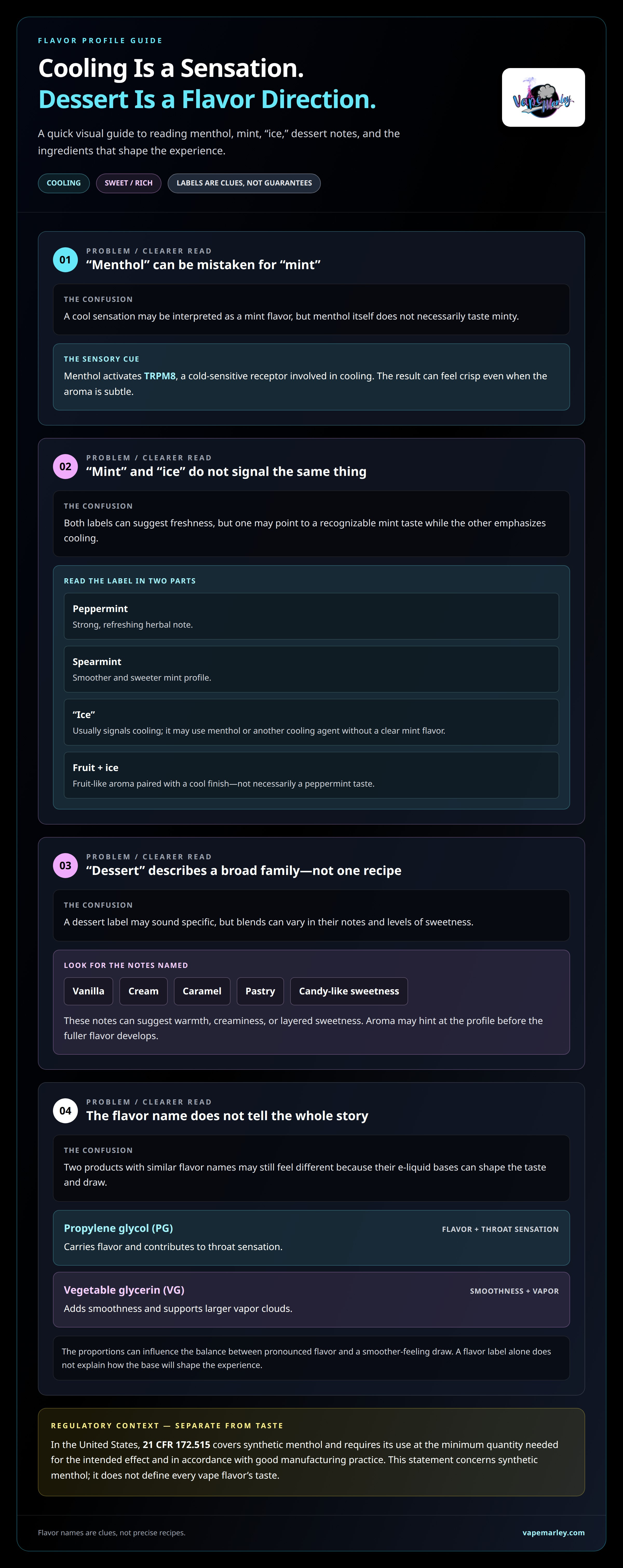
Menthol is defined by a cooling sensation, while dessert profiles emphasize sweetness and richness. The National Institutes of Health explains that menthol activates TRPM8, a cold-sensitive receptor involved in cooling. That sensation can make a flavor seem crisp, even when its aroma is subtle. A dessert profile such as vanilla custard or baked pastry instead suggests warmth, creaminess, or a layered sweet taste. These are different sensory directions: one foregrounds coolness, the other foregrounds indulgent flavor notes.
Menthol, mint, and “ice” aren’t interchangeable terms. Menthol creates a cooling sensation but doesn’t necessarily taste minty. Peppermint can add a strong, refreshing herbal note, while spearmint tends to taste smoother and sweeter. “Ice” usually signals cooling, but the blend may use menthol or another cooling agent without a clear mint flavor. For example, a fruit-and-ice profile may pair a berry-like aroma with a cool finish. Treat the flavor name as a clue, not a precise recipe, to set realistic expectations.
Dessert flavors often combine several recognizable notes. Vanilla, cream, caramel, and pastry-style accents can create a fuller impression than a single sweet note. A smooth, rich profile may linger differently from menthol’s brisk sensation. Some dessert blends suggest custard or baked goods; others lean toward candy-like sweetness. The balance depends on the flavoring blend, so “dessert” describes a broad family, not one consistent taste. Aroma can hint at the profile before the fuller flavor develops.
The e-liquid base also affects how these profiles come across. Propylene glycol carries flavor and contributes to throat sensation, while vegetable glycerin adds smoothness and supports larger vapor clouds. Their proportions can influence the balance between pronounced flavor and a smoother-feeling draw. A crisp menthol note, for instance, may seem more prominent in one blend, while a creamy dessert profile may feel softer in another. The flavor name alone doesn’t tell you how the base will shape the experience.
To compare labels, identify the main flavor first, then the added sensation. A mint-menthol description suggests both cooling and herbal flavor; an “ice” fruit description signals cooling alongside fruit. A vanilla or pastry description points toward a sweet, richer direction. In the United States, 21 CFR 172.515 covers synthetic menthol and requires use at the minimum quantity needed for the intended effect and in accordance with good manufacturing practice, according to the Electronic Code of Federal Regulations (eCFR). That regulatory statement concerns synthetic menthol; it doesn’t define every vape flavor’s taste. Distinguishing sensory cues from ingredient and regulatory details makes comparisons clearer.
What are common menthol and dessert flavor products in the United States?
U.S. vape listings commonly present flavors as standalone profiles or combinations. Menthol-style options include mint-forward blends, cooling “ice” profiles, and fruit paired with a cooling finish. Dessert choices generally use descriptions that signal sweet, rich flavors. These labels appear on bottled e-liquid and ready-to-use vaping products. The format tells you how the product is supplied; the flavor name describes its intended profile. A mint label, for example, signals a different flavor cue from a fruit-and-ice description.
Mint products can be distinguished by the type of mint named. Peppermint is commonly described as strong and refreshing, while spearmint is smoother and sweeter. Wintergreen is described as the sweetest of these three mint profiles. A menthol label may indicate cooling with mint flavoring, while an “ice” label may emphasize the cooling sensation instead. For example, “berry ice” points to fruit plus cooling, not necessarily a peppermint taste.
Dessert-style options center on sweet, indulgent impressions rather than cooling. Product descriptions may use terms such as bakery, cream, candy, or pastry to indicate the flavor direction. These words help distinguish a richer profile from a crisp mint blend, but they don’t specify one universal recipe. A dessert label can cover different combinations and levels of sweetness. Read the full flavor description, not just the broad category, to understand which notes the maker emphasizes.
Combination profiles bridge these categories. Fruit paired with menthol or another cooling agent can create a chilled-fruit character, while dessert blends focus on layered sweetness. Labels such as “fruit ice” or “mint dessert” are useful starting points, not exact guarantees of taste. To sort products, identify the main flavor first, then look for modifiers such as mint, ice, cream, or pastry. This quick two-part scan clarifies whether a product prioritizes cooling, sweetness, or both.
Format and e-liquid details also matter when comparing U.S. products. Bottled liquid is a different purchase format from a ready-to-use device, even when both have similar flavor names. For compatible refillable products, consider nicotine strength, the PG/VG ratio, and device compatibility together. Propylene glycol carries flavor and contributes to throat sensation; vegetable glycerin adds smoothness and supports larger vapor clouds. These ingredients can shape how mint, fruit, or dessert profiles come across. Match the flavor description and product format to the device category before choosing.
Menthol-labeled vape products are more likely to include mint flavoring, although menthol itself does not have a minty taste. Menthol and ice flavors generally provide the same cooling effect, with differences usually involving naming and whether mint flavor is included. In the United States, 21 CFR 101.22 defines flavor categories that include natural and artificial flavor classifications.
Fruit vape flavors can feel one-dimensional compared with layered dessert profiles, and some fruit vape flavors can taste artificial or candy-like. In the United States, 21 CFR 182.20 lists menthol, peppermint, and spearmint within its natural-extractives framework. These distinctions can help readers interpret flavor wording without treating a broad label as a guarantee of a specific taste.
Menthol vs. Dessert Flavor Popularity Among U.S. Consumers
No single flavor profile suits every U.S. vaper. Menthol and dessert options appeal to different sensory preferences, so popularity depends on what someone wants from a flavor. Someone seeking a crisp, cooling sensation may gravitate toward menthol or mint. Someone who prefers sweeter, richer notes may choose a dessert-style profile, such as custard or pastry. These are different reasons for choosing, not a universal ranking.
Menthol may appeal to people who value a brisk finish and recognizable cooling. It has also been associated with former menthol-cigarette smokers seeking a familiar flavor while switching to vaping. That connection helps explain why mint and menthol descriptions remain meaningful to some consumers. Others may prefer fruit paired with cooling, such as a berry-ice profile, which combines fruit character with a chilled sensation. “Ice” can signal cooling without promising a mint taste.
Dessert flavors attract interest through familiar sweet-food associations. Vanilla, caramel, cream, and baked-pastry notes can suggest a richer, more layered experience. The category offers several distinct directions rather than one standard taste. Someone drawn to a creamy profile may have different preferences from someone choosing candy-like sweetness. The shared appeal is the dessert-style character, not an identical flavor across every product.
The occasion can influence which profile appeals. Menthol’s cooling sensation may suit someone looking for a fresh-feeling flavor after exercise. A rich dessert profile may better match a slower evening routine or a preference for indulgent notes. These examples illustrate situational appeal; they don’t establish an overall winner. Temperature and personal taste can also shape the choice: a sweet, rich flavor may feel less appealing in warm weather or after a meal.
Flavor fatigue is another consideration with frequent use. Heavy sweetness can become tiring during a long session, while repeated menthol use may temporarily dull appreciation for non-menthol flavors. These experiences can affect whether someone sticks with one profile or alternates. For example, a vaper might choose a dessert flavor occasionally and a less-sweet fruit profile at other times. That’s a preference strategy, not evidence that one flavor family is more popular.
For a practical comparison, start with the sensation you want: cooling, sweetness, or a combination. Then consider a named profile, such as peppermint, berry ice, vanilla, or caramel. A flavor label identifies the intended direction, while personal taste determines which category appeals more. This preference-based approach is clearer than assuming U.S. consumers share one favorite.
Are menthol or dessert-flavored tobacco and vaping products legal in the United States
A flavor name alone doesn’t establish whether a tobacco-style or dessert-flavored vape may legally be sold. Menthol is commonly used in tobacco-style vapes to mimic menthol cigarettes, but that flavor purpose isn’t legal approval. The product category, its marketing status, and the rules governing its sale are separate considerations. A mint, menthol, or custard label describes flavor; it doesn’t answer every regulatory question.
One federal citation addresses synthetic menthol as a flavoring substance. According to the Electronic Code of Federal Regulations (eCFR), 21 CFR 172.515 covers synthetic menthol and requires use at the minimum quantity needed for the intended effect and in accordance with good manufacturing practice. That specific provision does not, by itself, establish that every menthol vape is authorized for sale. Nor does it answer the legal status of a dessert-flavored vape or tobacco product.
Keep ingredient rules separate from product rules. For example, a menthol ingredient could be addressed by a provision covering synthetic menthol, while a finished vaping product raises a different question about its marketing and sale. A dessert flavor name, such as vanilla or pastry, also doesn’t reveal the product’s regulatory status. Treating an ingredient rule as blanket permission for a finished product confuses two different levels of regulation.
A useful U.S. review separates the issue into three parts:
- Product type: Identify whether the item is a tobacco product, a vaping product, or an ingredient used in a product.
- Flavor description: Record whether the label says menthol, mint, ice, dessert, or a specific example such as custard.
- Legal question: Determine whether the question concerns ingredient use, marketing, sale, or possession.
These distinctions matter because “menthol” can describe a flavor profile or refer to synthetic menthol as an ingredient. “Dessert” usually identifies a broad flavor family, not one substance. Neither label provides a complete legal answer on its own. For instance, a fruit-ice description may indicate cooling without identifying the specific cooling compound. Similarly, a caramel dessert label doesn’t identify every flavoring ingredient.
For a specific product, keep the package description and product category clear when interpreting a rule. Don’t treat 21 CFR 172.515 as a blanket ruling on all U.S. vape sales. It addresses synthetic menthol’s use under stated conditions. A complete legality answer depends on the product and the particular legal question being asked, not simply whether its flavor is menthol or dessert.
Menthol vape flavors provide a strong cooling sensation and a noticeable throat hit, while ice vape flavors provide a smooth cooling effect, often without mint flavor. Fruit vape flavors can be paired with menthol to create a cooler, ice-like sensation.
What health risks are associated with menthol and dessert-flavored tobacco or vaping products
A menthol, “ice,” or dessert label describes a flavor direction, not a health-risk rating. A mint-flavored vape and a vanilla dessert vape, for example, differ in flavor category, but that distinction doesn’t establish which is safer. Flavor alone also doesn’t identify every ingredient or explain how a product is used. Keep taste descriptions separate from health conclusions, especially when comparing tobacco products with vaping products.
One specific concern with cooling profiles is throat harshness. High concentrations of cooling agents can feel harsh on the throat for some users, including in an “ice” profile that doesn’t taste minty. A strong cooling effect may feel sharp rather than refreshing. That sensation is a reason to stop and reassess use, not proof by itself of a particular injury or diagnosis.
Menthol and dessert profiles shouldn’t be treated as equal measures of exposure. Menthol describes a cooling sensation or flavor component; dessert can describe notes such as vanilla, cream, or pastry. Neither category label provides enough detail to compare health effects. A tobacco-style product and a vaping product also aren’t interchangeable simply because both use a menthol-like flavor. Product type and context of use matter more than flavor family alone.
For a more careful comparison, separate three questions:
- What is the product? Identify whether it is a tobacco product or a vaping product.
- What does the flavor label indicate? Distinguish mint, menthol, or ice from dessert notes such as caramel or custard.
- What sensation occurs? Notice whether cooling feels comfortable or harsh, particularly with strongly cooling profiles.
These distinctions help prevent flavor intensity from being mistaken for a health assessment. A dessert blend that tastes mild, for example, isn’t thereby proven safer than a menthol blend. A pronounced throat sensation also doesn’t reveal a product’s full health profile. Flavor descriptions can help identify preferences, but they can’t replace evidence about a product and its effects. Don’t use “smooth,” “cool,” or “rich” as shorthand for safety.
If a cooling vape feels harsh, discontinue use rather than trying to push through the sensation. If symptoms persist or concern you, seek guidance from a qualified health professional. The same cautious approach applies if a dessert flavor feels irritating; sweetness doesn’t rule out discomfort. The key point is specific: concentrated cooling agents may feel harsh to some users, while a flavor label alone can’t establish the overall risk of a tobacco or vaping product.
VapeMarley
After comparing cooling and dessert-style profiles, continue your product search with VapeMarley. Its range includes disposable vapes, vape accessories, and vape bundles. Use what you’ve learned about flavor descriptions to identify your preference, then consider which product format suits your needs. Flavor labels describe intended taste, while accessories and bundles support different product choices. Keeping these distinctions clear can make browsing more focused, without treating a flavor name as a promise of an exact experience.
For questions as you consider your options, contact VapeMarley.
Make Your Next Flavor Choice More Deliberate
Use the menthol-versus-dessert comparison to clarify what you want, rather than treating it as a contest with one universal winner. Before choosing, consider which qualities matter most: a cooling sensation, a sweeter profile, or a balance between the two. That preference can guide your next step without relying on a flavor name alone.
You can also keep a simple note of flavor profiles you enjoy and those you’d rather avoid. A few words, such as “less sweet” or “cooling without mint,” can help focus future choices. If product details leave you with questions, seek guidance before deciding.
Contact VapeMarley with your questions, and take your next step with a clearer sense of what you prefer.
Frequently Asked Questions
What Does Menthol Taste Like?
Menthol tastes cool and crisp, though its overall flavor depends on the blend. On its own, menthol creates cooling rather than a distinctly minty taste. A peppermint-flavored vape adds a stronger herbal note, while a menthol tobacco-style profile can combine cooling with tobacco-like flavor. If a product says “ice,” expect a cooling cue, but not necessarily a mint taste. Flavor descriptions help set expectations, though individual blends differ.
What does “menthol vs. dessert” mean in the search context?
It describes a shopper’s intention to compare two broad flavor experiences before choosing a product. The comparison can clarify whether someone prefers a cooling, fresh-feeling profile or sweeter, richer notes. It doesn’t mean one flavor is objectively better or more popular. Someone deciding between mint and vanilla, for example, can compare the sensation, aroma, and flavor intensity they prefer, then consider which product format suits them.
What should consumers consider when choosing between menthol and dessert flavors?
Compare the sensation you prefer, product format, device compatibility, and nicotine details shown in the product description. All purchases require age verification at checkout. Our products are for adult users only - no exceptions. Many of our products contain nicotine, an addictive chemical; keep them out of reach of children and pets. If unsure about use, consult a medical professional. For product questions, contact support@vapemarley.com or text +1 (765) 201-0461.