
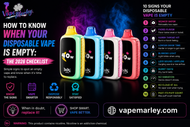
How to Know When Your Disposable Vape is Empty: The 2026 Checklist
Jul 16th 2026
That harsh, acrid hit you just got? It's not a fluke. It's your disposable vape telling you something important, but figuring out exactly what it's saying is trickier than most people expect. Knowing how to know when disposable vape is empty has become a genuine diagnostic skill in 2026, because today's devices are far more sophisticated than the simple single-use sticks of just a few years ago.
You already know the frustration: one minute you're enjoying a smooth draw, and the next you're getting a burnt, tasteless hit with no warning. It's a common experience, and the confusion is completely understandable. The real problem is that a dead battery and a depleted e-liquid reservoir can feel almost identical, and treating them the same way wastes both your time and your device.
That's exactly what this checklist solves. We'll walk you through a clear, step-by-step diagnostic process built around the indicators found on modern 2026 devices, so you can confidently identify what's actually wrong and know precisely when it's time to reach for a replacement.
Key Takeaways
- Knowing how to know when disposable vape is empty requires distinguishing between two very different problems — a depleted e-liquid reservoir and a dead battery — because the symptoms can feel nearly identical.
- Modern 2026 devices come equipped with smart screens and LED indicators that take the guesswork out of the equation, but only if you know how to read their signals correctly.
- A simple two-step diagnostic checklist — checking charge status and performing a weight test — can confirm whether your device is truly finished or just needs a quick recharge.
- Your actual puff count depends heavily on how you vape; long-draw users will reach the empty point significantly faster than short-puffers, regardless of what the device's rated count says.
- Having a vape bundle on hand is the most practical way to eliminate the frustration of an empty device entirely, ensuring you always have a fully charged, ready-to-use replacement within reach.
Sensory Telltale Signs: Tasting the End of Your Device
Your senses are the first diagnostic tool you have, and they're surprisingly reliable. Before any LED flashes or screen alerts you to a problem, your taste buds and lungs are already picking up the signal. Learning to interpret these physical cues is a foundational part of knowing how to know when disposable vape is empty, and it starts with understanding what's actually happening inside the device.
To understand how disposable vapes work at a mechanical level is to understand why these sensory shifts happen. The atomizer coil heats the wicking material, which draws e-liquid from the reservoir and converts it into vapor. When that reservoir runs low, the entire chain of events becomes compromised, and your palate is the first to notice.
The Burnt Taste (Dry Hits)
A dry hit occurs when the wicking material, typically a cotton or mesh composite, doesn't have enough e-liquid saturating it before the coil fires. The coil heats the dry wick directly, producing that sharp, acrid, almost chemical taste that makes most people pull the device away from their lips immediately. It's unpleasant for a reason: it's a signal to stop.
Here's the nuance that most guides miss. Not every dry hit means the reservoir is empty. An air bubble can temporarily block e-liquid flow to the wick, mimicking the same sensation. If you get one harsh hit followed by several normal ones, an air bubble is likely the culprit. But if the burnt taste is consistent across multiple draws with no recovery, the reservoir is genuinely depleted and continuing to puff won't improve anything. It will only degrade the wick further, making the experience worse.
Vapor Density and Throat Hit
Flavor degradation is the subtler warning sign that arrives before the full dry hit. As the e-liquid level drops, the wick becomes less saturated, and the resulting vapor becomes thinner and less flavorful. You might notice the familiar taste of your chosen flavor becoming muted or hollow, a phenomenon sometimes called flavor ghosting.
The throat hit weakens alongside it. Nicotine delivery becomes inconsistent as the coil struggles to vaporize the diminishing liquid, so that satisfying chest sensation starts to fade. Your exhale cloud also shrinks noticeably.
High-PG liquids tend to show these signs more abruptly because PG carries flavor more directly. High-VG formulas may produce thinner clouds gradually before the taste fully drops off. Either way, the pattern is the same: diminishing returns with every puff. That progression is one of the clearest sensory indicators that it's time to consider a replacement, which is precisely why keeping a backup device from a vape bundle on hand makes practical sense.
Knowing how to know when disposable vape is empty through taste and vapor quality alone gives you a head start, but sensory signals are just the beginning of the diagnostic process.
Hardware and Digital Indicators: 2026 Device Signals
Sensory cues give you an early warning, but modern hardware takes the guesswork out entirely. The 2026 generation of disposable vapes has moved well beyond a single blinking light, and understanding what your device is actually communicating is a core part of knowing how to know when disposable vape is empty with real confidence.
Smart Screens and E-Liquid Sensors
Higher-end 2026 disposables now feature small OLED or LCD screens that display an e-liquid percentage alongside a battery indicator. These sensors work by continuously measuring the electrical resistance of the wicking material. A saturated wick conducts differently than a dry one, so the onboard chip translates that resistance reading into an estimated fill percentage.
The operative word is estimated. Resistance-based sensing is accurate under normal conditions, but it can drift if the device has been sitting unused for several days, if the ambient temperature is very cold, or if a thick, high-VG liquid has partially crystallized around the wick. A screen showing 15% that also produces weak, muted flavor is a device that's genuinely close to empty. A screen frozen on the same percentage across multiple sessions is likely a sensor calibration issue, not an accurate reading. When the two signals conflict, trust your palate over the display.
Frozen or stuck readouts are more common than manufacturers acknowledge. If your screen won't update, a firm tap on the base of the device can sometimes dislodge an air pocket that's interfering with the sensor. If the display stays static, treat the device as empty and move on rather than continuing to draw on a potentially dry wick.
LED Blinking Codes
For devices without screens, LED patterns carry the diagnostic load. While there's no single universal standard across every manufacturer, a widely adopted convention in 2026 models uses the following logic:
- 10 rapid blinks: Battery depletion. The device has charge left but not enough to fire the coil consistently.
- 3 to 5 slow blinks followed by cutoff: E-liquid low or depleted. The coil fired but sensed insufficient liquid resistance.
- Continuous light without drawing: Auto-firing. Disconnect from any charging port immediately and do not use the device.
Color coding adds another layer. Green typically signals adequate charge and liquid. Blue often indicates a mid-range battery state. Red is the universal alert for low battery, low liquid, or both. Check your device's packaging for its specific code sheet, since color assignments aren't identical across every brand.
Transparent viewing windows, found on many mid-range disposables, remain one of the most reliable indicators available. A quick visual check under decent lighting tells you exactly where the liquid level sits, no sensor required.
It's also worth keeping the broader picture in mind: disposable vapes contain batteries, plastics, and residual nicotine liquid, all of which have documented environmental impacts of e-cigarette waste that make responsible disposal important once a device is confirmed empty.
Once you've confirmed your device is genuinely finished rather than just low on battery, having a replacement ready eliminates the frustration entirely. Exploring disposable vape bundles is the most practical way to ensure you're never caught without a fully charged, ready-to-use device.
Diagnostic Checklist: Empty Tank vs. Dead Battery
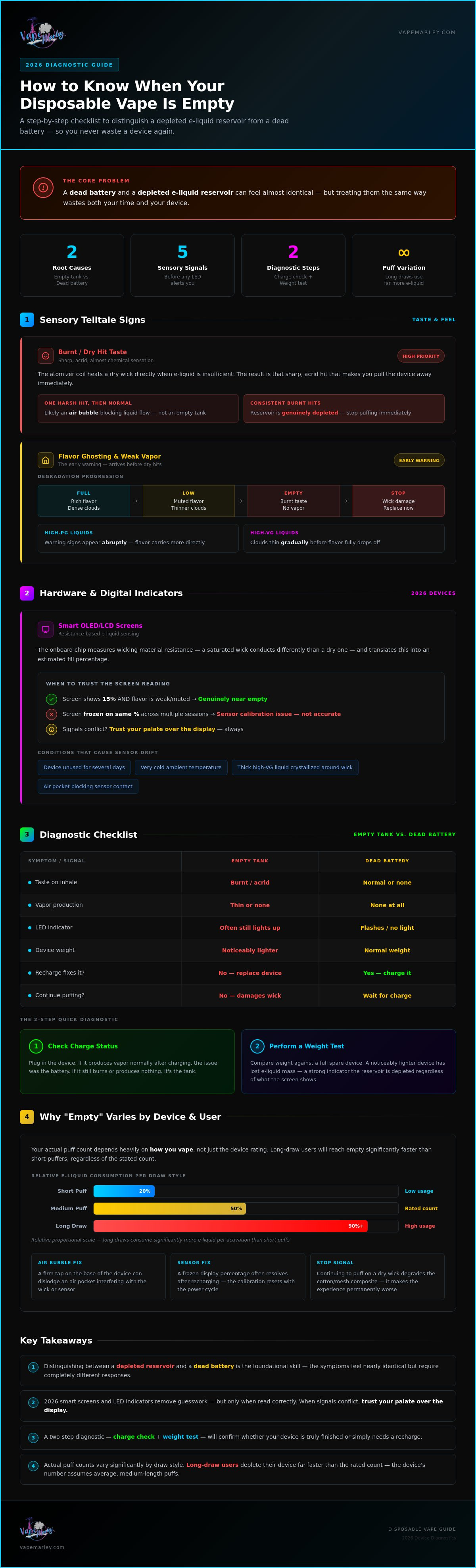
Here's where most vapers go wrong: they assume a device that stops producing vapor is simply dead and toss it. But knowing how to know when disposable vape is empty means running a quick four-step check before you make that call. The difference between a depleted tank and a dead battery isn't always obvious, and the fix, or the decision to replace, depends entirely on which problem you're actually dealing with.
Work through these steps in order. Each one narrows the diagnosis.
Step 1: Check the charge status. If your device is rechargeable, plug it in for 15 minutes and try again. A device that immediately produces strong, flavorful vapor after a short charge had a battery issue, not an empty tank. One that still delivers weak, tasteless hits after charging is telling you the e-liquid is gone. The charge restored the power, but there's nothing left to vaporize.
Step 2: Perform the weight test. Pick up a fresh device of the same model and compare it to your current one. A meaningfully lighter device has consumed most of its e-liquid. This isn't a precise measurement, but the difference between a full reservoir and a depleted one is noticeable with most mid-to-large capacity disposables. If the weights feel comparable, the tank may still have liquid, and the battery is the more likely culprit.
Step 3: Listen for the sizzle. Take a slow, deliberate draw and pay attention to the sound. A functioning atomizer produces a faint, consistent crackling or sizzle as it vaporizes liquid. Silence, or a hollow airflow sound with no crackle, indicates the coil is firing against a dry wick. That's an empty tank signal, not a battery failure.
Step 4: Check the airflow. A completely blocked draw with no airflow at all usually points to a structural clog, condensation buildup in the mouthpiece, or a flooded chamber, not an empty device. Try a gentle, forceful exhale through the mouthpiece (never inhale to test this) to clear any obstruction. If airflow returns but vapor quality remains poor, circle back to steps one through three.
Rechargeable Disposable Troubleshooting
Rechargeable disposables add a layer of complexity worth understanding separately. As covered in the rechargeable disposable vapes longevity guide, these devices are designed for multiple charge cycles across their e-liquid lifespan. The key diagnostic distinction is the "cold hit": when the battery is too weak to fully heat the coil, you'll get a draw that feels cool and thin, with vapor but almost no throat hit or flavor. That's not an empty tank. It's a battery that needs a charge. A genuinely empty tank, by contrast, produces a warm or hot draw with a harsh, burnt quality and no flavor payoff whatsoever.
A battery that charges repeatedly but still delivers cold hits after a full cycle is likely no longer holding charge effectively. At that point, even if liquid remains, the device has reached the end of its functional life. Replace it rather than continuing to draw.
Non-Rechargeable Limitations
Standard non-rechargeable disposables are engineered so the battery outlasts the e-liquid in most normal use cases. Occasionally, particularly with heavy, long-draw usage, the liquid runs out while battery capacity remains. The result is a device that still activates but delivers nothing useful. According to FDA guidance on e-cigarettes and disposable vaping devices, these products contain pressurized components and lithium batteries that are not designed for consumer disassembly.
Do not attempt to open, pierce, or attach a charging cable to a standard disposable. The advice circulating online suggesting otherwise is genuinely dangerous. For realistic lifespan expectations before you reach this point, the how long does a disposable vape last guide breaks down puff counts by usage pattern so you can plan replacements proactively rather than reactively.
Running through this checklist takes under two minutes and gives you a clear answer every time. Once you've confirmed the device is genuinely finished, the only practical solution is a replacement, which is exactly why keeping a vape bundle on hand eliminates the diagnostic frustration entirely.
Maximizing Your Puffs: Why "Empty" Varies by Device
A 20,000-puff device sounds like it should last considerably longer than a 5,000-puff one. Sometimes it does. Sometimes the gap is far narrower than the numbers suggest. The rated puff count on any disposable is calculated under laboratory conditions using a standardized draw duration, typically around one second per puff. Your actual vaping behavior is almost certainly different, and that gap between the lab and real life is where most people's confusion about how to know when disposable vape is empty actually begins.
Puff Count vs. Real-World Usage
The 2026 generation of high-capacity devices has introduced "Pulse" or "Boost" modes that deliver a more intense hit by increasing coil wattage on demand. The tradeoff is significant: running a device in Boost Mode can deplete your e-liquid reservoir at roughly double the rate of standard mode, because the coil vaporizes more liquid per activation. A device rated at 15,000 puffs in standard mode might realistically deliver closer to 7,000 to 8,000 in continuous Boost Mode. The high puff count disposable vape guide breaks down how these ratings translate across different device categories and usage styles.
Long-draw vapers compound the issue further. A three-second draw vaporizes substantially more liquid than a one-second draw, regardless of mode. If you're a slow, deliberate inhaler, your personal "vape lifespan" will consistently fall short of the rated count. Tracking how many days a device lasts across two or three consecutive purchases gives you a reliable personal baseline, which makes planning your next order far more accurate than trusting the label alone.
Environmental Factors
Storage conditions quietly drain your device before you ever take a puff. Leaving a disposable in a hot car is one of the most common causes of premature emptiness, because elevated temperatures accelerate e-liquid evaporation through the mouthpiece and can cause the reservoir to leak internally. You may pick up a device that feels full by weight but delivers noticeably weaker vapor simply because heat degraded the liquid's composition.
Chain-vaping creates a different but related problem. Drawing repeatedly without pause prevents the wick from re-saturating between puffs, which produces the same dry-hit sensation as an empty tank even when liquid remains. This is a coil saturation issue, not an empty reservoir, and it's easily fixed.
- Rest your device for 30 to 60 seconds between draws to allow the wick to re-saturate fully.
- After a harsh hit, wait two minutes before drawing again. Residual liquid often migrates back to the wick, delivering a few additional usable puffs.
- Store devices upright and away from direct sunlight to minimize passive evaporation and leaking.
Mesh coils, now standard across most quality 2026 disposables, help extract every usable drop by distributing heat more evenly across a larger wick surface area. They're more efficient than traditional wire coils, but they can't compensate for poor storage or aggressive draw habits. Understanding how to know when disposable vape is empty means accounting for all of these variables, not just the number printed on the box. Browse disposable vapes and bundles to find devices matched to your actual usage pattern rather than a marketing estimate.
Transitioning: What to Do When the Checklist is Complete
You've run the diagnostic. You've confirmed the device is genuinely finished. Knowing how to know when disposable vape is empty is only half the equation; what you do in the next five minutes determines whether this becomes a minor inconvenience or a recurring frustration. Two actions matter here: replacing the device intelligently and disposing of the old one responsibly.
Avoiding the "Empty Vape" Emergency
The most reliable solution to an empty device isn't a faster diagnostic process. It's never being caught with only one device in the first place. The math behind vape bundle deals makes this straightforward: buying two or three devices together typically costs less per unit than purchasing individually, and you eliminate the gap between finishing one device and receiving the next order entirely.
Most experienced vapers in 2026 treat a two-to-three device rotation as standard practice. When one device enters its final third, based on the sensory and hardware cues covered earlier, you open the next. No emergency. No waiting. The transition is seamless.
Choosing your next device is also an opportunity to refine your experience based on what you just learned. If your current flavor felt too sharp toward the end, a higher-VG formula in your next pick will deliver a smoother finish as the reservoir depletes. If you found yourself in Boost Mode more than standard, a higher-capacity device will serve your actual usage pattern better than the one you just finished. The how to choose a disposable vape guide walks through exactly these variables so your next purchase is a genuine upgrade, not just a repeat.
Responsible Disposal
Tossing a spent disposable vape into the household bin isn't just wasteful; it's a documented fire hazard. Lithium-ion batteries in landfill conditions can short-circuit, overheat, and ignite. The plastics and residual nicotine liquid compound the environmental problem further.
The responsible path is straightforward. Most municipalities have e-waste collection points, and many vape retailers participate in take-back programs. A quick search for local e-waste recycling centers will locate the nearest drop-off point. Some areas also have dedicated battery recycling bins at hardware and electronics retailers.
Use this checklist for a clean, responsible transition every time:
- Confirm the device is empty using the four-step diagnostic before disposal.
- Do not puncture, crush, or attempt to open any part of the device.
- Locate your nearest e-waste drop-off rather than using standard household waste.
- Open your backup device from your bundle immediately so you're never without one.
- Note how long the finished device lasted to calibrate your next order quantity accurately.
That last point matters more than most people realize. Tracking your personal device lifespan across a few cycles gives you the data to order proactively rather than reactively. Pair that habit with a bundle order from VapeMarley, and the question of how to know when disposable vape is empty becomes far less urgent because you'll always have a fully charged replacement ready before the current one runs out.
You Now Have the Tools. Use Them.
Knowing how to know when disposable vape is empty comes down to reading three things in sequence: what your senses are telling you, what your device's indicators are showing, and which of the four diagnostic steps confirms the real problem. A burnt taste, a blinking LED, and a lightweight device all point to the same conclusion. Trust the pattern.
The bigger lesson from this checklist is a simple one. Running out mid-session is almost always preventable. Track your personal device lifespan, open your backup before the current one fails, and dispose of finished devices responsibly at an e-waste drop-off rather than the household bin.
When you're ready to build that backup supply, VapeMarley makes it straightforward. Curated high-puff count variety packs, authenticity guaranteed on every brand, and fast, discreet US shipping mean your next device arrives before you need it, not after. Browse our 2026 Disposable Vape Bundles and never run dry again!
You've got the knowledge. Now keep the supply to match it.
Frequently Asked Questions
Why does my disposable vape taste burnt even though it is new?
A burnt taste on a brand-new device almost always means the wick wasn't fully saturated before the coil fired. This happens when a device has been stored upright for an extended period and the liquid has settled away from the wicking material. Take two or three short, gentle primer puffs without activating the device, then wait 60 seconds before your first full draw. That pause allows e-liquid to migrate back into the wick properly.
Manufacturing defects are less common but possible. If the burnt taste persists through five or more puffs on a fresh device, the wick may have been dry-assembled or the coil may be faulty. Contact the retailer rather than continuing to draw, as a persistently dry coil on a new device won't self-correct.
Can I refill a disposable vape once it is empty?
Technically, some disposables can be opened and refilled, but it's not recommended and carries real risks. Disposable casings aren't designed for repeated sealing, so leaks are common after any attempt to pry them apart. More importantly, the coil and wick have already been heat-cycled through thousands of puffs, meaning vapor quality from a refilled device will be noticeably degraded compared to a fresh one.
There's also a safety consideration. Forcing open a device that contains a lithium battery creates puncture and short-circuit risks. A replacement device from a curated bundle is a far safer and more cost-effective solution than attempting a DIY refill on a spent disposable.
How many days should a 10,000 puff disposable last?
That depends almost entirely on your draw habits. A casual vaper taking 100 to 150 puffs per day could reasonably expect a 10,000-puff device to last 60 to 100 days. A heavier user drawing 300 or more times daily would exhaust the same device in roughly 30 days. The rated count is calculated using standardized one-second draws in a lab setting, which rarely reflects real-world behavior.
Running the device in a high-wattage or Boost Mode, if available, cuts that count significantly because more liquid is vaporized per activation. Track how long two or three consecutive devices last at your actual usage pattern. That personal baseline is far more reliable than the number printed on the packaging.
What does a blinking blue light mean on my disposable vape?
Blue LEDs on most 2026 disposables indicate a mid-range battery state, essentially a visual equivalent of a half-full charge indicator. It's a status signal, not an alert, meaning the device is functioning normally but the battery is no longer at full capacity. You'll typically see this after a recharge cycle on a rechargeable model or partway through the life of a non-rechargeable device.
Color coding isn't universal across every brand, so the blue signal on your specific device may carry a different meaning. Check the indicator legend on your device's original packaging. If that's unavailable, a rapid blue blink specifically during a draw attempt usually signals low battery rather than a simple status update, and that distinction matters when you're diagnosing why vapor quality has dropped.
Is there any way to get more hits out of an empty vape?
If the diagnostic checklist confirms the tank is genuinely empty, no technique will produce usable vapor. The wick has nothing left to vaporize, and continued draws only heat dry cotton or mesh, which degrades the coil and produces the harsh, chemical taste covered earlier in this guide. Knowing how to know when disposable vape is empty means recognizing when a device has reached its actual limit rather than chasing hits that won't improve.
If the device isn't fully empty but delivering weak hits, resting it for two to three minutes sometimes allows residual liquid to migrate back into the wick, producing a few additional usable puffs. Storing the device horizontally during that rest period can help. But once consistent dry hits arrive with no recovery between draws, the device is finished and should be disposed of responsibly at an e-waste drop-off point.
Why is my vape leaking e-liquid from the bottom?
Bottom leaking typically points to one of three causes: a flooded chamber from over-priming, a cracked or poorly sealed reservoir from physical damage, or temperature-related thinning of the e-liquid. High-VG liquids become noticeably more fluid in warm environments, and a device left in a hot car or direct sunlight can develop leaks that wouldn't occur at room temperature. The liquid thins enough to bypass the wicking material and seep through the air inlet.
A leaking device isn't just messy; it's losing usable e-liquid with every drop. Store devices upright at room temperature to minimize passive leaking, and avoid leaving them in vehicles during warm weather. If leaking is severe or the device has been physically dropped, the seal integrity may be compromised enough that continued use isn't practical.
Does the battery or the juice run out first in a disposable?
In most properly engineered disposables, the e-liquid is designed to deplete first, with the battery retaining enough charge to vaporize the final drops. Manufacturers calibrate battery capacity to outlast the reservoir under standard usage conditions. This is intentional; a device that dies from battery failure before the liquid is gone wastes product and frustrates users.
The exception is heavy, long-draw usage. Vapers who take extended draws repeatedly without pause can exhaust the liquid while meaningful battery capacity remains. The device will still activate and the LED will show charge, but there's nothing left to vaporize. This is one reason rechargeable disposables are a practical choice for heavier users; they ensure battery life never becomes the limiting factor before the liquid is fully consumed.
How do I know if my rechargeable vape is charging or dead?
Most rechargeable disposables signal active charging with a pulsing or solid LED, often red or white, that switches off or changes color once the charge cycle completes. If you plug in the device and see no indicator light at all, the battery may be too deeply discharged to respond immediately. Leave it connected for 10 to 15 minutes before concluding it's dead; deeply depleted lithium cells sometimes need a brief trickle charge before the indicator activates.
A device that shows a charging indicator but still delivers cold, weak hits after a full charge cycle is no longer holding charge effectively. That's a battery degradation issue, not a liquid problem, and it signals the device has reached the end of its functional life. At that point, replace it rather than continuing to charge and redraw; a battery that won't hold charge won't improve with additional cycles.