

How do disposable vape batteries work?
Posted by Silar on Nov 10th 2026
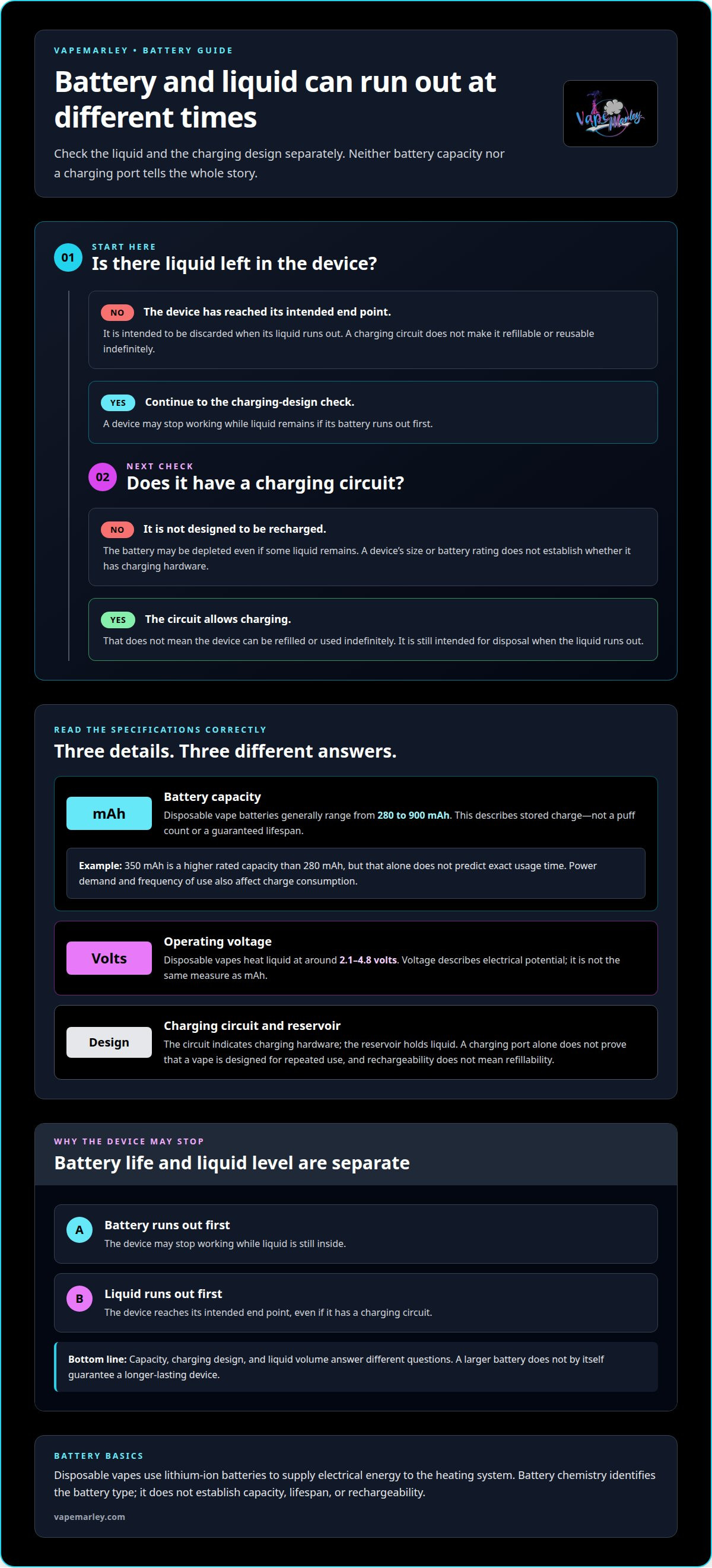
A disposable vape’s battery and liquid don’t always run out at the same time. Disposable vape batteries generally range from 280 to 900 mAh, and whether a device can be recharged depends on whether it has a charging circuit. Even devices with one are intended to be discarded when their liquid runs out.
It’s easy to assume a larger battery automatically means a longer-lasting vape, but capacity is only part of the picture. How often you use the device and how it operates also affect how long its charge lasts.
This guide explains what battery capacity means, how to tell whether a disposable vape is rechargeable, and why battery life may not match the amount of liquid remaining. You’ll also learn how the battery powers the device and what to consider when choosing disposable vapes and accessories.
Key Takeaways
- Battery capacity can vary widely, so the mAh rating offers a useful starting point for understanding how much charge a device can hold.
- A charging port doesn’t mean a vape is designed for repeated use; the presence of a charging circuit and the remaining liquid both matter.
- Learn what lithium-ion batteries do in a disposable vape and why battery life may not match the amount of liquid left.
- According to the U.S. Environmental Protection Agency, vape devices with lithium-ion batteries should be recycled rather than placed in regular trash.
- Understand the handling practices that can help reduce risks from battery damage, short circuits, and charging.
Disposable vape battery capacity and rechargeability
Capacity, charging design, and liquid volume all affect how a disposable vape is used. A battery’s milliamp-hour rating describes its stored charge, but it doesn’t tell you exactly how long the device will last.
Capacity and Potential Reuse
Disposable vape batteries generally range from 280 to 900 mAh. A device with a 350 mAh battery has more rated capacity than one with a 280 mAh battery, but that comparison alone doesn’t predict exact usage time. The device’s power demand and how often it is used also affect how quickly its charge is consumed.
Think of mAh as a measure of electrical charge, not a puff count or a promise of a particular lifespan. Two devices with the same rating can use their charge differently because their designs and power demands may differ. Capacity is a useful comparison point, but it can’t tell you how much liquid remains or whether a device is intended to be recharged. It’s one piece of information, not a direct measure of how long disposable vape batteries will last in everyday use.
Rechargeability depends on the device’s design. Some disposable vapes include a charging circuit, particularly devices with larger liquid reservoirs. That circuit allows charging, but it doesn’t make the device reusable indefinitely: these products are still intended to be discarded when their liquid runs out. Treat a charging port or circuit as a feature for the device’s intended use, not as evidence that it can be refilled or used after the liquid is gone.
Battery capacity and liquid volume are separate measures. A larger reservoir may provide more liquid, while the battery supplies the energy needed to heat it. If the battery runs out first, the device may stop working with liquid still inside. If the liquid runs out first, a rechargeable circuit doesn’t change the device’s intended end point.
Battery Types
Disposable vapes use lithium-ion batteries, which store energy and supply it to the heating system. The device converts that stored energy into heat for vaporizing liquid. Operating voltage varies: disposable vapes heat liquid at around 2.1-4.8 volts. That range describes voltage, while mAh describes battery capacity, so the two figures measure different things.
When comparing a device, treat the battery rating, charging design, and liquid reservoir as separate details. For example, a 350 mAh rating describes capacity; it doesn’t identify the reservoir size or prove that the device has a charging circuit. Similarly, a larger liquid reservoir doesn’t reveal the battery’s mAh rating. Each detail answers a different question about how the vape is designed.
This distinction explains why “rechargeable” and “refillable” aren’t interchangeable. A charging circuit supplies energy to the battery; a reservoir holds the vape liquid. Even when a device can be charged, it is still intended for disposal after its liquid runs out. Rechargeability alone doesn’t mean the reservoir can be refilled.
Use the stated battery capacity and charging design to understand how a device is intended to work, rather than inferring either from its size. A compact body doesn’t provide a reliable capacity figure, and a larger body doesn’t establish how long the battery lasts. Capacity, circuitry, and reservoir size offer different clues about how disposable vape batteries are designed and used.
What kind of batteries are used in disposable vapes?
Disposable vapes use lithium-ion batteries to supply electrical energy to the heating system. The battery converts chemical energy into electrical energy, which the device directs to the component that heats the liquid. This is the battery’s core role, whether the vape has a charging circuit or is designed for single-use operation.
“Lithium-ion” describes the battery chemistry, not a particular capacity, shape, or expected lifespan. Capacity is measured in milliamp-hours, while voltage describes electrical potential. These specifications answer different questions: capacity indicates stored charge, while voltage relates to how the device supplies power to its heating system.
The battery is only one part of the electrical system. A disposable vape also needs connections to carry power from the cell to the heating component. In a device with a charging circuit, that circuit manages incoming power during charging. A charging port alone doesn’t reveal the battery’s condition or how much liquid remains.
Protection circuitry is another design feature to consider. Some disposable vape batteries lack protection against over-discharge, overcharging, short circuits, and dangerously high current. These safeguards are separate from the lithium-ion chemistry itself. Their presence or absence relates to how the device manages electrical risks, not how much charge the battery holds.
That distinction matters if a device stops producing vapor. The battery may be discharged, the liquid may be depleted, or another part may no longer function. The lithium-ion label doesn’t identify the cause, nor does it mean the device can be safely opened, repaired, or connected directly to a power source.
Don’t treat disposable vape batteries as loose cells for experimentation. The battery sits inside a device designed to deliver power through its own connections and circuitry. Connecting it directly to a power source bypasses the charging circuit. Damaging the cell or causing a short can increase risk, so disassembly isn’t a suitable way to test battery chemistry.
For a practical comparison, separate three details: chemistry, capacity, and charging design. Lithium-ion identifies the battery type; a milliamp-hour figure describes capacity; and a charging circuit indicates whether the device has charging hardware. Seeing “lithium-ion,” for example, doesn’t establish that a vape is rechargeable. These details work together, but none replaces the others.
As a battery discharges, it eventually reaches a point where it can no longer power the heating system as intended. The device’s design determines how its stored energy is delivered. Don’t assume that a familiar battery label means every disposable vape behaves alike. Circuitry and construction affect how each battery is used, and the device should remain intact rather than being dismantled to inspect its cell.
the page says some airlines permit passengers to carry up to 15-20 disposable vapes. That figure describes a stated allowance for carrying devices; it does not say what lithium-ion chemistry a particular device uses, what capacity its battery has, or whether it has a charging circuit. Those are separate details. A carrying allowance cannot be used as a proxy for any of them, and it does not identify the state of an individual battery or device.
It also doesn’t establish whether a particular vape is rechargeable, how much charge remains, or whether its protection circuitry guards against over-discharge, overcharging, short circuits, or dangerously high current. The number refers to devices permitted for carriage, not a battery rating or measure of stored charge. Keep these categories distinct when comparing disposable vapes: a statement about carrying quantity cannot replace details about chemistry, capacity, charging design, or electrical condition.
How should you dispose of or recycle disposable vape batteries in the United States?
Vape devices contain lithium-ion batteries, so disposal matters even when a device appears empty or no longer works. The U.S. Environmental Protection Agency says vape devices with lithium-ion batteries should be recycled, not placed in regular trash, because of fire risks. Treat the whole device as battery-containing waste, not ordinary household rubbish.
Keep the vape intact. Don’t open its casing to remove the battery for recycling. A lithium battery can be damaged or shorted during disassembly, creating additional risk. If the device is still assembled, focus on handling and recycling the complete item rather than separating its components at home.
Keep recycling separate from regular waste. The EPA’s guidance points to a dedicated collection route for battery-containing products. Don’t put the vape in a household trash bag, which sends it into the regular waste stream instead of battery recycling. The battery’s small size doesn’t remove the fire risk.
Prepare the device without opening it
Keep an intact vape in a stable place while arranging recycling. Avoid crushing, bending, puncturing, or otherwise damaging its casing, as this can affect the battery inside. The device’s appearance may not show whether its cell is charged or damaged, so don’t treat a nonworking vape as risk-free.
- Keep it whole: Don’t pry open the casing to extract the cell.
- Keep it separate: Don’t mix the vape into ordinary household trash.
- Handle it gently: Avoid pressure or impact that could damage the battery.
- Use recycling: Follow the route intended for battery-containing vape devices.
These steps focus on safe handling rather than home disassembly and keep the device together for recycling. If a vape is already damaged, don’t press, cut, or pull at the battery area. Avoid actions that could cause a short circuit while moving or storing it.
If the battery has already been removed
A loose lithium battery needs careful handling. Cover exposed contacts to help prevent an accidental short circuit, and store the cell in a fireproof battery bag. These precautions apply to a battery that has already been removed; they aren’t a reason to open an intact vape. Keep the battery away from objects that could bridge its terminals.
For example, don’t leave a loose cell among metal objects. Contact between exposed terminals and conductive material can cause a short. A fireproof battery bag provides a contained storage option while the removed battery awaits recycling. Handle the cell carefully, and don’t connect it directly to a power source.
For an intact vape in the United States, recycling is the key decision: the EPA says battery-powered vape devices belong in recycling, not regular trash. Keep the device undamaged, avoid opening it, and cover the contacts on any battery that has already been removed. These steps reduce unnecessary handling and help keep the battery out of ordinary waste.
For a removed lithium cell, use a fireproof battery bag for storage. Keep it separate from household waste and send it to battery recycling rather than treating it as ordinary rubbish.
What are the fire and injury risks of disposable vape batteries?
A lithium battery can become hazardous if damaged, shorted, charged incorrectly, or discharged below its minimum voltage. These conditions can cause overheating or fire, creating a burn risk and endangering nearby materials. Handle the device as an electrical item, not an empty casing to treat roughly. The risks from disposable vape batteries depend partly on how the cell and its circuitry are handled.
Charging requires particular care. Don’t leave a battery unattended while charging or connect it directly to a power source. It needs an appropriately configured charging circuit. A charging port doesn’t make improvised cables or direct connections safe. If the charging setup is damaged, don’t bypass its circuit or improvise another connection.
Battery protection varies by device. Some disposable vape batteries lack circuitry to protect against overcharging, over-discharge, short circuits, and dangerously high current. These safeguards are separate from lithium-ion chemistry. Their presence or absence relates to how the device manages electrical risks, not how much charge its battery holds. Don’t assume every device has the same protections.
Keep these practical precautions in mind:
- Stay nearby during charging: Don’t leave a lithium battery unattended while it charges.
- Use the intended charging circuit: Never connect a battery directly to a power source.
- Avoid deep discharge: Don’t discharge a lithium battery below its minimum voltage level.
- Prevent physical damage: Don’t puncture, crush, or short a battery during handling.
Disassembly creates another clear risk. Opening a vape can expose the battery and its contacts. A slipping tool or one that bridges the terminals may cause a short circuit, while pressure or punctures can damage the cell. Don’t dismantle a device to test its battery or attempt an improvised repair. Keeping disposable vape batteries enclosed in their original device avoids unnecessary contact with exposed components.
Charging behavior matters even when a device has a charging circuit. Follow the intended charging setup, and stop rather than improvise if the connection is damaged. Stay nearby while charging. These steps reduce the chance of charging faults or unnoticed overheating. If you see signs of damage, don’t try to make the device work by pressing, bending, or opening it.
Discharge can also affect battery safety. Each lithium battery has a minimum voltage level, and dropping below that threshold can damage the cell. Don’t force a depleted vape to keep working or repeatedly draw power after it stops. A battery that no longer powers the device isn’t a reason to open the casing and remove it.
If a vape is physically damaged, don’t squeeze or bend it to inspect the battery. A compromised cell or electrical connection can make handling more hazardous. Don’t attempt to charge it through a direct power connection or dismantle it. Safer handling is straightforward: avoid damage, use only the intended charging circuit, and stay nearby while charging.
For devices that fit your preferences, explore disposable vapes, and handle each one according to its intended design.
VapeMarley: Disposable Vapes
VapeMarley helps you explore disposable vapes when you’re ready to choose a device after learning how its battery and liquid work. Understanding capacity, charging design, and intended disposal can help you make an informed choice. VapeMarley also offers vape accessories and bundles to consider alongside individual devices.
As you browse, remember that a charging circuit doesn’t mean a vape is refillable or intended for use after its liquid runs out. Choose with your preferences and the device’s intended use in mind.
For help with your next step, contact VapeMarley.
Choose Your Next Vape With Your Priorities in Mind
Start your next device decision with your daily routine, not a single specification. Consider practical factors such as portability, ease of handling, and how much device care you prefer. Battery design is part of the bigger picture, alongside the experience you want from a vape. This helps your choice reflect practical priorities rather than assumptions based on appearance or one feature.
Understanding disposable vape batteries gives you a useful basis for evaluating your options. Keep your preferences in mind as you consider devices, and make responsible use part of your expectations from the start. As your needs change, revisit what matters to you rather than assuming the same choice will always fit. A thoughtful decision begins with knowing what you value and keeping it in focus.
If you have a question while deciding what fits your routine, ask VapeMarley about your options. Take the next step when you’re ready, with your priorities clearly in mind.
Frequently Asked Questions
What mAh capacity is typical for a disposable vape?
Typical capacities range from 280 to 900 mAh. For disposable vape batteries, the mAh figure indicates stored charge, not an exact puff count or guaranteed runtime. A higher rating can mean greater capacity, but it doesn’t alone show how long a device lasts. For example, compare capacity alongside the device’s power demand and your usage habits rather than treating mAh as a lifespan estimate.
Can you recharge a disposable vape battery, and is it safe?
You can recharge a disposable vape only if its design includes a charging circuit. A charging port doesn’t mean the device is refillable or intended for ongoing reuse. Use the intended charging setup, stay nearby while it charges, and never connect the battery directly to a power source. Don’t open or modify the vape to charge its battery, especially if the charging connection is damaged.
How long do disposable vape batteries last?
There’s no single runtime for disposable vape batteries. Capacity, power demand, and how often you use the device all influence how quickly its charge runs down. Battery charge and liquid can also run out at different times. A device may stop working while liquid remains, or its liquid may be depleted before the battery’s charge is fully used.