
Disposable Vape Battery Safety: How to Use, Charge, and Dispose of Devices
Sep 29th 2026
Is it safe to plug in a disposable vape, or could charging a damaged device make it overheat? The answer depends on the exact model. Some disposable vapes are rechargeable; others are not. A charging port alone does not prove a device is designed to recharge, so check the manufacturer’s instructions before connecting it. Disposable vape battery safety starts with following guidance for the specific device, not guessing based on its appearance.
This guide explains how to check whether a device is rechargeable, recognize warning signs such as unusual heat, swelling, leaks, or damage, and decide when to stop using it. You’ll also learn why used vapes should not go in household trash or recycling bins, and how to find an appropriate local battery or e-waste collection option. The key steps are simple: follow device-specific instructions, respond promptly to warning signs, and check the right disposal route when a vape reaches the end of its use.
Key Takeaways
- Disposable vape designs vary. Identify the exact device and check its instructions before charging or handling it.
- Good disposable vape battery safety starts with inspecting the device and using only the charging method and compatible accessories specified by the manufacturer.
- Know which signs mean you should stop using a device, and avoid handling one that appears damaged or behaves unusually.
- Store devices away from extreme temperatures, moisture, children, and pets. Take extra care when transporting them.
- Before disposing of a used device, check your local waste authority or battery and e-waste program for accepted drop-off options.
What Is a Disposable Vape Battery, and Why Does Safe Handling Matter?
A disposable vape battery powers the device’s internal components, including the part that heats the liquid into an aerosol. Battery construction, location, and charging design vary by model, so don’t assume one device’s features or instructions apply to another. For a general overview of electronic-cigarette components, see What Is a Disposable Vape Battery.
Safe handling means avoiding unnecessary stress or damage to the device. Physical impact, extreme temperatures, moisture, and charging methods the manufacturer does not specify can contribute to malfunction. That does not mean every disposable vape is hazardous. It means you should follow the instructions for the exact model you have. This device-specific approach is central to disposable vape battery safety.
Do all disposable vapes have rechargeable batteries?
No. Rechargeability depends on the model, and appearance alone is not a reliable way to tell whether a device can be charged. Check the markings on the device and read the manufacturer’s instructions before connecting a cable. If the instructions do not clearly say the vape is rechargeable, do not try to charge it. Never open or modify a disposable device to reach its battery, or try to add charging capability the manufacturer has not specified.
What battery information should users check first?
Start with the manufacturer’s instructions and any safety warnings printed on the device or packaging. If the device is rechargeable, check the specified charging method, compatible accessories, and what its indicator lights mean. Don’t guess what an indicator means or rely on information from another model. Battery chemistry and technical specifications can differ, so if they are not listed, don’t make assumptions.
Before using or charging the device, check for obvious changes such as a cracked casing, leakage, or unusual heat. These signs do not identify the exact fault, but they are reasons to stop and consult the manufacturer’s guidance rather than continue using or charging the vape. Follow the instructions for the device in hand, even if another model looks similar.
How to Charge a Rechargeable Disposable Vape More Safely
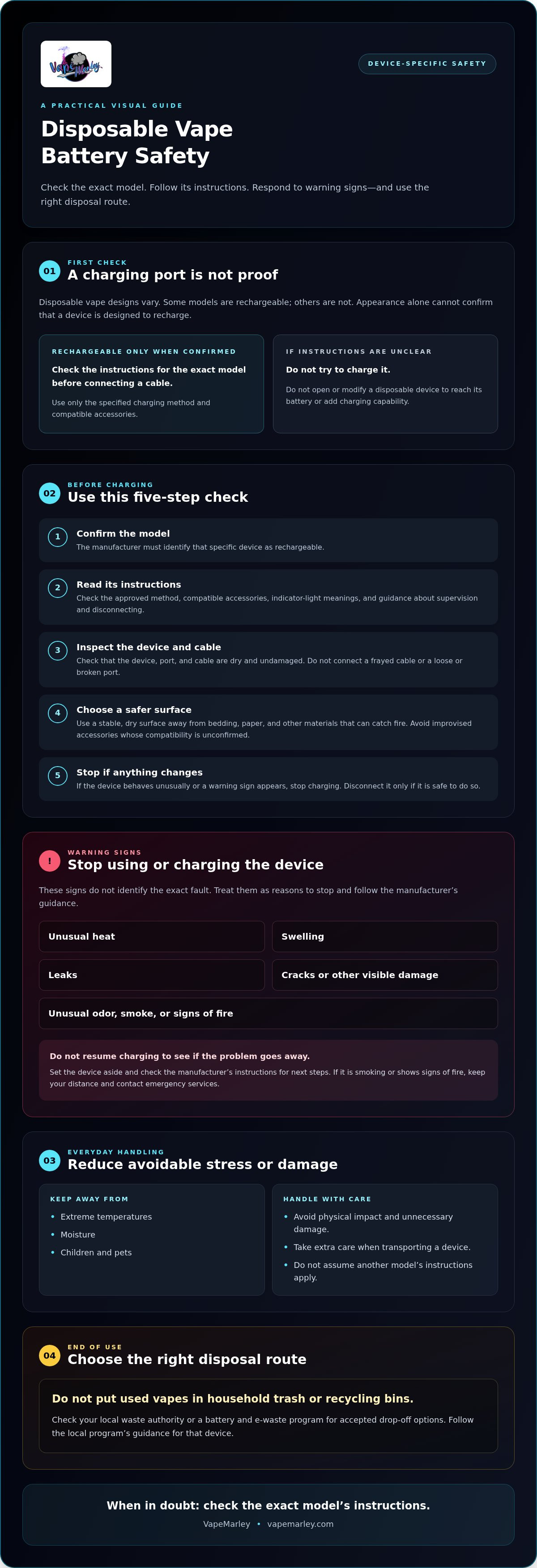
Charge a disposable vape only if the manufacturer identifies that specific model as rechargeable. A port, or a cable that fits, does not confirm that charging is intended. Use this simple sequence: confirm that the model is rechargeable, inspect the device and port, then follow the manufacturer’s charging instructions exactly.
What should you check before connecting a charger?
Read the instructions to confirm the approved charging method and compatible accessories. Check that the port is clean and undamaged, and that the device is dry and free of visible damage. Don’t connect it if the cable is frayed, the port is loose or broken, or the device looks compromised. Avoid improvised adapters and accessories if their compatibility is not confirmed.
What charging habits reduce avoidable risks?
Use a stable, dry surface away from bedding, paper, and other materials that can catch fire. Follow the manufacturer’s instructions about supervision and when to disconnect the device. If the charging guidance is unclear or unavailable, contact the manufacturer rather than trying an alternative method. The FDA’s vape battery fire and explosion prevention tips offer additional safety guidance.
Watch for changes while the device is charging. Stop charging if it becomes unusually hot, swells, leaks, appears damaged, or gives off an unusual odor. Don’t resume charging to see whether the problem goes away. Set the device aside and check the manufacturer’s instructions for next steps. If it is smoking or shows signs of fire, keep your distance and contact emergency services.
- Confirm: The exact model is rechargeable.
- Inspect: The device, charging port, and cable are dry and undamaged.
- Connect: Use only the manufacturer-specified charging method and compatible accessories.
- Place: Charge on a stable, dry surface away from combustible materials.
- Stop: Stop charging if warning signs appear. Disconnect the device only if it is safe to do so.
These steps support disposable vape battery safety without assuming all devices share the same design. If you’re comparing disposable vapes or accessories, review the information provided for each device at VapeMarley’s online store, then follow the manufacturer’s charging instructions.
Are Disposable Vape Batteries Dangerous? Warning Signs to Take Seriously
A disposable vape battery can pose a risk if the device is damaged, misused, or exposed to unsuitable conditions, but a battery incident is not inevitable. Watch for changes instead of assuming every vape is hazardous. Warning signs include unusual or persistent heat, swelling, leaking, visible damage, smoke, or a hissing sound. These signs do not reveal the cause, but they do mean you should stop using the device.
Battery incidents are possible, particularly when a battery is damaged or overheats. The U.S. Environmental Protection Agency explains why e-cigarettes require careful handling and disposal in its guidance on How to Dispose of a Disposable Vape Battery Responsibly. For practical disposable vape battery safety, treat unusual changes as a reason to stop, not as a problem to troubleshoot yourself.
What should you do if a vape battery gets hot or damaged?
Stop using the device and don’t charge it. Keep people and pets away, and don’t open, puncture, or attempt to repair it. Avoid handling a hot device. If it is smoking, on fire, or creating immediate danger, move away and contact emergency services. Don’t put yourself at risk trying to carry or contain it.
Can a disposable vape battery catch fire?
Yes, a battery incident can include a fire, but that does not mean every disposable vape will catch fire. Unusual heat, swelling, physical damage, smoke, or hissing are warning signs, not proof that a failure is certain. Stop using and charging the device if any of these signs appear. If there is smoke or fire, prioritize getting away and contacting emergency services over handling the device.
- Stop: Don’t use or charge a suspect device.
- Keep clear: Don’t touch a hot, smoking, or hissing vape.
- Get help: Move away and contact emergency services if there is fire or immediate danger.
- Don’t tamper: Never open, puncture, or try to fix the battery.
A Practical Checklist for Storing and Handling Disposable Vape Devices
Everyday care can help prevent avoidable damage to a disposable vape and its battery. Follow the instructions for the specific device, since storage and transport guidance can vary. There is no single temperature range that can be assumed safe for every model, so check the manufacturer’s recommendations instead of relying on a generic limit. These habits support disposable vape battery safety without suggesting that all devices have identical designs.
How should you store a disposable vape?
Choose a secure, dry place where the device will not be exposed to moisture, prolonged direct sunlight, or extreme heat or cold. Keep it out of reach of children and pets, and away from combustible materials. Avoid leaving it where it could be crushed, such as under heavy items or in a crowded bag. If the manufacturer provides specific storage instructions, follow them rather than guessing at a temperature threshold.
How can you prevent accidental battery damage?
Consider what the device might come into contact with during daily use or transport. Keys and coins can scratch or damage it, while sharp objects or pressure can compromise its casing. Carry it separately from loose metal objects, and don’t put it somewhere it could be bent, crushed, or exposed to liquid. If you’re traveling, check current carrier rules and official requirements before packing a vape. Restrictions can depend on the carrier and type of travel.
- Daily handling: Keep the device dry and avoid dropping, crushing, opening, or puncturing it.
- Storage: Follow model-specific guidance and keep the vape away from extreme temperatures, direct sunlight, children, pets, and combustible materials.
- Transport: Protect it from pressure and contact with keys, coins, or sharp objects. Check applicable carrier rules before traveling.
- After damage: Don’t keep using a device that is cracked, leaking, or otherwise compromised. Avoid unnecessary handling and follow the manufacturer’s guidance for next steps.
Basic precautions help you handle a device responsibly, but they do not replace product-specific instructions. If you’re considering a disposable vape or related accessory, review the available options at VapeMarley’s disposable vapes and accessories, then check the instructions for the exact device before use.
How to Dispose of a Disposable Vape Battery Responsibly
A used disposable vape contains a battery and electronic components, so it may need a different disposal route from ordinary household waste. The U.S. Environmental Protection Agency advises consumers not to put e-cigarettes in household trash or recycling because batteries can create fire risks and the devices may contain hazardous materials. Collection options and local instructions vary, so check before dropping off a device instead of assuming a particular bin or program will accept it.
Can you put a disposable vape in household trash or recycling?
Don’t assume a disposable vape belongs in household trash or a recycling bin. Check your local waste authority’s current guidance and ask whether a battery collection, household hazardous waste, or e-waste program accepts whole vape devices. Some programs may have specific instructions for batteries or devices that contain nicotine, so confirm what they accept and how to prepare the item. The EPA’s e-cigarette disposal guidance for individuals is a useful starting point, but local program directions determine the appropriate option available to you.
Where can you find device-specific help?
Check the manufacturer’s instructions or contact the manufacturer for guidance on the device’s end of life. Don’t open or dismantle a vape to remove its battery, since doing so can damage the device. If it is swollen, leaking, or otherwise damaged, tell the local collection program before bringing it in and ask how it should be handled. Don’t put a damaged device in a collection bin unless the program confirms that it is acceptable.
Search your local government’s waste or recycling website for terms such as “household hazardous waste,” “battery collection,” and “e-waste.” Confirm which items the program accepts, its drop-off instructions, and any special handling guidance. Responsible disposable vape battery safety includes checking the disposal route before you go, not just choosing a familiar-looking bin.
VapeMarley is an online retailer that uses age verification. That process is not a battery safety certification or a disposal service. For retailer product information, explore VapeMarley’s product information, and rely on the specific manufacturer’s instructions for device handling and disposal.
Make Safer Choices at Every Step
Good disposable vape battery safety comes down to a few practical habits: check the instructions for the exact device, charge it only if the manufacturer says it is rechargeable, and stop using it if you notice unusual heat, swelling, leakage, damage, smoke, or hissing. Don’t open or repair a suspect device. If it is smoking or on fire, move away and contact emergency services.
Store devices securely, away from extreme temperatures, moisture, children, and pets. When a vape is used up, check your local waste authority or battery and e-waste programs for accepted disposal options. A quick check can help you avoid putting a battery-containing device in the wrong collection stream.
For product information, explore VapeMarley’s disposable vapes and accessories. VapeMarley uses age verification for online purchases, but that process is not a safety certification. Follow the manufacturer’s guidance for the device you choose and your local disposal instructions when it reaches the end of its use.
Frequently Asked Questions
Can you recharge a disposable vape?
Only if the manufacturer says that specific model is rechargeable. Disposable vape designs vary, and a port or cable that fits does not confirm that charging is intended. Check the device markings and instructions before connecting anything. If rechargeability or the approved charging method is unclear, don’t try to charge it. Never modify or open a device to add charging capability.
Is it safe to leave a disposable vape charging overnight?
Don’t leave a disposable vape charging overnight unless the manufacturer’s instructions explicitly say this is appropriate. Follow the device-specific guidance on supervision, charging method, and when to disconnect it. Charge only on a stable, dry surface, away from bedding, paper, and other flammable materials. Stop charging if the device becomes unusually hot, swollen, damaged, or gives off an unusual odor.
What should you do if a disposable vape battery gets hot?
Stop using or charging the device, and don’t handle it if it is too hot to touch safely. Keep people and pets away. Don’t open, puncture, or attempt to repair it. If you see smoke or fire, or there is immediate danger, move away and contact emergency services. If the device is hot but there is no smoke or fire, consult the manufacturer’s guidance for next steps.
How should you store a disposable vape safely?
Follow the storage instructions for the specific device. As a general precaution, keep it dry and away from prolonged direct sunlight, extreme heat or cold, children, pets, and combustible materials. Avoid storing it where it could be crushed, such as under heavy items or loose beside sharp objects. Don’t assume one temperature limit applies to every disposable vape.
Can disposable vapes go in the regular trash?
Don’t assume a disposable vape belongs in household trash or a recycling bin. The device contains a battery and electronic components, and the U.S. Environmental Protection Agency advises consumers to keep e-cigarettes out of both. Check your local waste authority for accepted options, such as household hazardous waste, battery collection, or e-waste programs. Confirm that the program accepts whole vape devices before drop-off.
What should you do with a damaged or leaking disposable vape?
Stop using and charging it. Don’t open or puncture the device, or treat it as safe to use. Keep people and pets away, and avoid touching any leaking material. Contact the manufacturer for device-specific instructions and ask your local waste or hazardous-waste program how to handle the damaged vape. If it becomes hot, smokes, or catches fire, move away and contact emergency services.